

18th May 2026
Children North East welcomes today’s announcement from Rachel Reeves that the two-child limit benefit scheme will be scrapped from April 2026.
This is a moment worth celebrating. After years of tireless campaigning, today’s decision represents hope, fairness, and progress for families across the country. It is a testament to the power of collective action and the voices of those who have stood together to challenge injustice. We celebrate alongside the families who will finally see change, and with our partners who have worked relentlessly to make this possible including those from End Child Poverty and North East Child Poverty Commission.
This is a significant step forward that will lift 350,000 children out of poverty, including around 19,500 families in the North East. For over a decade, this policy has forced families into hardship, and we have campaigned endlessly alongside End Child Poverty and the North East Child Poverty Commission to bring it to an end.
Removing the limit means families will finally have more money in their pockets – enabling them to provide fairer opportunities for their babies, children and young people, it will enable them to spend more time together, and access experiences such as after-school clubs that were previously out of reach. We know too well how poverty contributes to long-term health problems, stress, relationship breakdowns, and mental health challenges. Ensuring families receive this for each of their children will help level the playing field and allow all children to thrive.
This decision offers a moment of relief and hope, but our fight to end child poverty continues. We now look to the forthcoming National Child Poverty Strategy to set out the government’s long-term plan to ensure that every baby, child, and young person can grow up happy, healthy, and free from the barriers of poverty.
18th May 2026

30th April 2026
How Little Minds in Mind Helped One Mum Feel Like Herself Again

16th April 2026
Masquer‑Aid: Building Confidence, Community and Self‑Advocacy

1st April 2026

We are proud to share that, as of November 2025, our Poverty Proofing® work is officially recognised as a trademarked methodology. This is a landmark achievement in our journey, acknowledging the profound impact of our commitment to removing barriers created by poverty across the communities and settings we work with.
Since 2011, we have developed and refined our Poverty Proofing the School Day model, which has since expanded to encompass healthcare, early years, and arts and culture. At its core, Poverty Proofing ensures that spaces and their users are shielded from the effects of poverty, that hidden barriers are identified, and that everyone involved gains a deeper understanding of what poverty is and how it can be addressed. While we recognise that poverty is a systemic issue that cannot be solved by any single space or individual, our work focuses on reducing its impact on babies, children, young people, and their families.
Trademark recognition means that every individual, organisation, or setting we have partnered with carries a stamp of legitimacy and impact. It signifies not only collaboration with us and the application of our expertise, but also that the work created together is recognised more widely as meaningful and effective.
The trademarking of Poverty Proofing is more than a legal milestone – it is a powerful affirmation of the value, integrity, and legitimacy of our methodology. It ensures that the framework we have built over more than a decade is protected, respected, and continues to grow as a trusted approach to tackling the effects of poverty.
This achievement strengthens our commitment to working alongside schools, healthcare providers, cultural organisations, and communities to uncover hidden barriers and create environments where everyone can thrive. Poverty Proofing is now more than a practice; it is a recognised standard of excellence, a symbol of collaboration, and powerful ethos and a promise that together we can reduce the impact of poverty on children, families, and communities.
18th May 2026
30th April 2026
How Little Minds in Mind Helped One Mum Feel Like Herself Again
16th April 2026
Masquer‑Aid: Building Confidence, Community and Self‑Advocacy
1st April 2026
We have officially opened the doors on our first ever flagship shop – a milestone moment in our 134-year history!
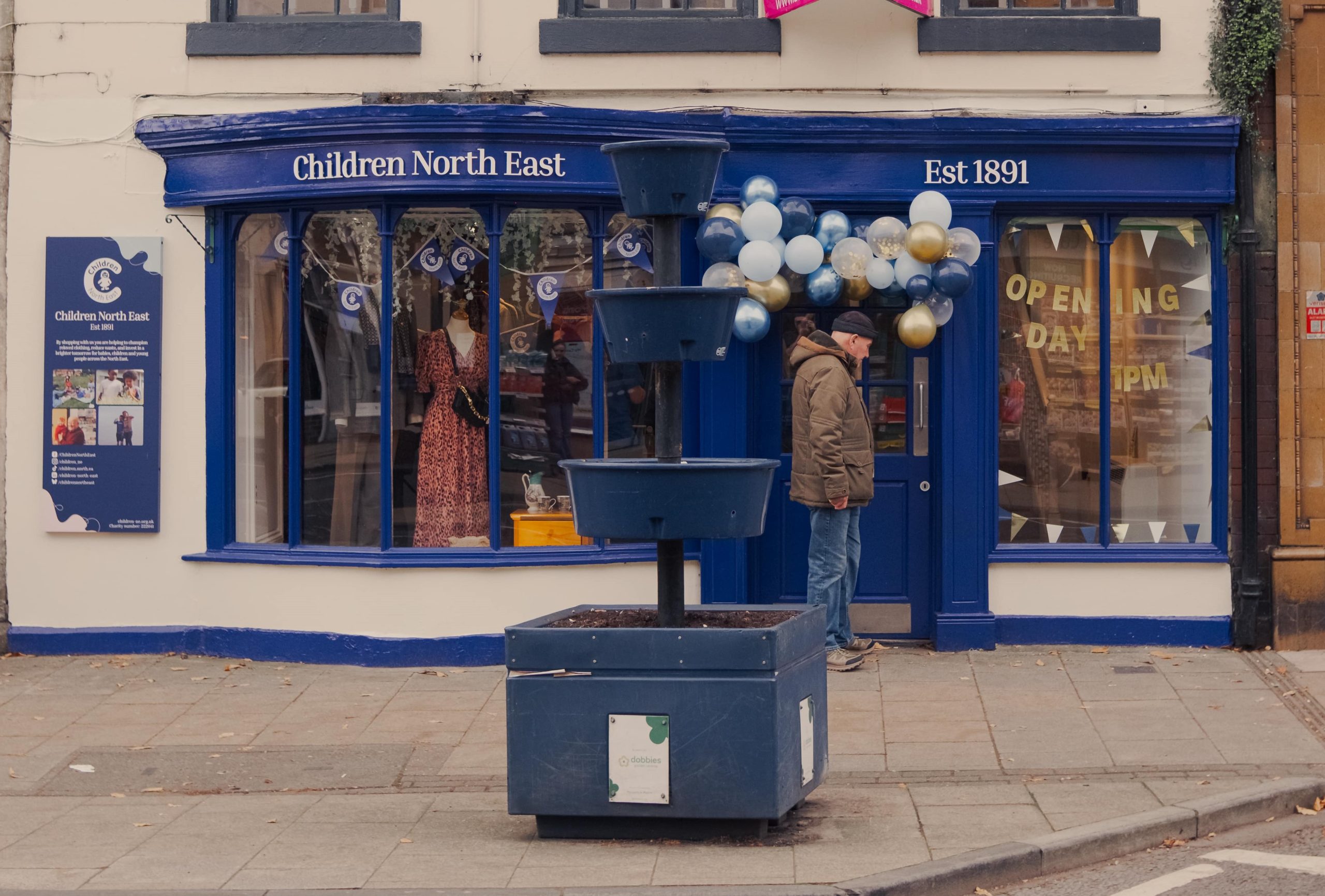
Children North East have worked since 1891 to provide generations of support for babies, children and young people to grow up happy and healthy across the North East. Providing essential services like mental health counselling, support for families in crisis, and safe spaces that help children overcome obstacles and thrive.
This October, we opened the doors on the newest venture, a two-storey shop stocking clothing, footwear, accessories, toys, books and games, with a dedicated children’s section, there’s something for everyone! Every donation and purchase will fund programmes and initiatives that provide meaningful change for the next generation.
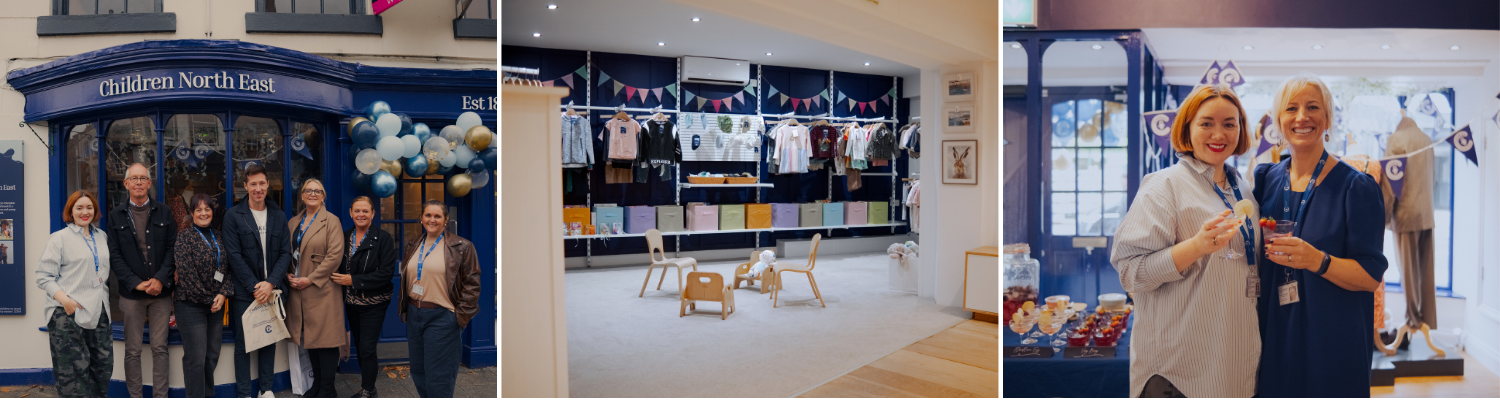
Our Chief Executive, Leigh Elliott said “This is such an incredible moment for the charity, and one we’ve been looking forward to for some time. Thanks to the dedication and commitment of our wonderful staff and supporters, we’ve been able to create this beautiful shop space and become part of Morpeth’s vibrant retail community. Our work supporting babies, children, young people and their families is so important for the region, and we’re looking forward to building our legacy through this new fundraising stream.”
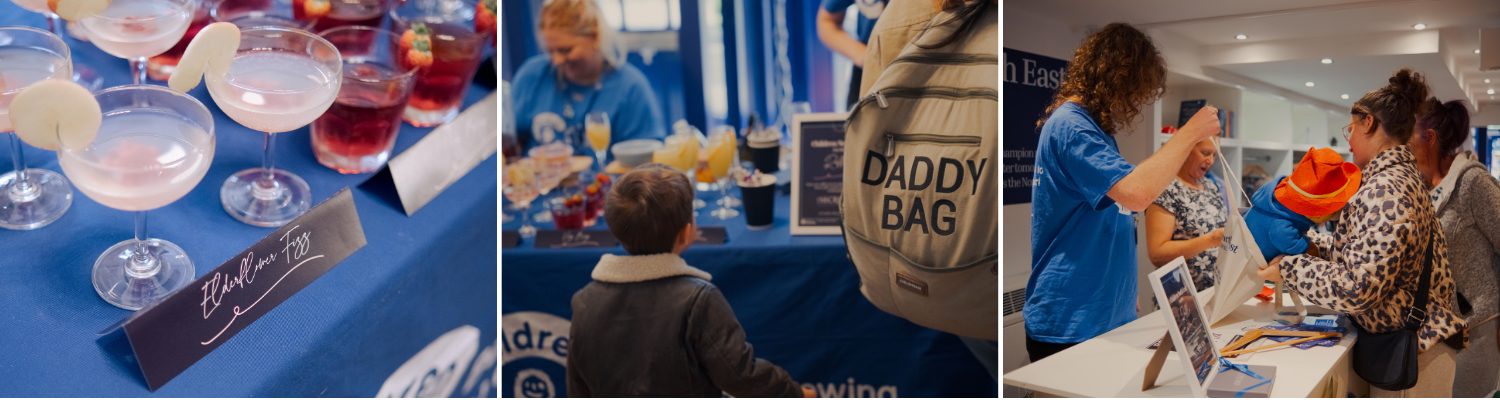
The grand opening event welcomed trustees, stakeholders and members of the public for a day of celebration, connection, and community spirit. The day began with a private showing of the new retail space, followed by a lively Sip & Shop launch featuring premium mocktails, exclusive discounts, and a raffle prize draw.
The shop is located on Bridge Street and is open Tuesday to Saturday from 10am – 4pm. We are accepting donations during open hours, and the staff are excited to meet the public and local community. If you’re interested in Volunteering opportunities, contact the team on [email protected] or visit Our Flagship Shop
18th May 2026
30th April 2026
How Little Minds in Mind Helped One Mum Feel Like Herself Again
16th April 2026
Masquer‑Aid: Building Confidence, Community and Self‑Advocacy
1st April 2026
Our Chief Executive recently set out the case for ending the two-child limit From the CEO: Why we must end the cruel two-child limit. That’s why, along with over 100 organisations in the North East, we signed a letter, coordinated by the North East Child Poverty Commission, calling for the end of this cruel policy – Every child deserves an equal chance in life.
Like all organisations campaigning for ending this policy we had hoped that the Prime Minister would have announced its removal at last week’s Labour Party conference, especially given both the candidates for the Deputy Leadership have signalled their strong support for this position and that child poverty was given a prominent mention.
Now it seems like we must wait for the budget on 26th November or the publication of the national child poverty strategy.
We want to restate our position that the two-child limit must end, and that Government must set a timetable for this to be implemented as soon as possible. It is the single biggest action that any Government could take to lift children out of poverty and so must be at the heart of the budget and the national strategy for a Government serious about eliminating child poverty.
Any broad commitment to scrap the limit is of little comfort to those families struggling right now, who will be worrying about going into the winter with energy costs rising.
Similarly, any compromise to limit changes such as a three-child limit, would clearly be better for some families but ignore the considerable evidence of the impact scrapping the limit would make, it would be the worst kind of politics to compromise on.
The limit must go, in full, and as soon as possible.
Anything else continues to let our children down.
18th May 2026
30th April 2026
How Little Minds in Mind Helped One Mum Feel Like Herself Again
16th April 2026
Masquer‑Aid: Building Confidence, Community and Self‑Advocacy
1st April 2026
Our Poverty Proofing Culture team work to support culture venues be more inclusive and accessible to everyone, allowing equal opportunities for children and young people to thrive. This blog piece, by guest writer Susan, highlights one mum’s experience of feeling excluded from a culture venue. When any new policies are bought in, often it’s those on low income who feel the effects the most – even if the new rules are not specifically about costs. We’re working to ensure every space feels accessible and inclusive to anyone visiting, helping to shift the culture of culture settings.
The arts, culture and heritage sector have historically struggled to engage people from “non-traditional” audiences; people on low incomes and from working class communities feeling these experiences are “not for them”. Some brilliant work has been done in recent years to identify and remove barriers and widen participation and accessibility of venues and opportunities. But is there a risk that, when the ‘next big thing’ comes along, all this progress will be lost?
Step forward Martyn’s Law. A new law that requires public venues and events to improve their security and implement proportionate security measures.
This vitally important new piece of legislation should keep people safer at major events and venues. It received royal assent in the spring, but with a minimum two-year implementation period, and statutory guidance yet to be published.
Nonetheless some organisations are keen to get ahead of the game. But hasty implementation could easily lead to them alienating the very audiences venues are trying to include.
Engagement with people less inclined to access cultural venues consistently shows it is not just cost that prevents participation, but the “culture” of culture itself – the fear of not knowing the rules or how to behave, of facing stigma and disapproval of staff. This was precisely my recent experience at a venue in the North East.
In implementing Martyn’s Law, the venue in question has deemed a particular category of bag an inherent security risk and subject them to an outright ban. Naturally this is the exact type of bag I use on a day-to-day basis, for completely practical reasons, to carry all the bits and pieces I invariably need when out and about with my gaggle of small children.
But here is the problem – I had absolutely no idea that this policy had been brought in, despite weekly visits to the building over the last year, receiving countless emails and following their social media. Moreover, the zealous implementation of the new policy wasn’t at a sold-out, high-profile event, but a Sunday afternoon kids showcase, the audience mostly made up of frazzled parents who had spent the last hour and a half waiting around, in the heat, trying to keep small children contained, over lunchtime.
My experience was horrible. I was completely blindsided when security told me I wasn’t allowed in because of my bag, initially totally confused before rapidly spiralling into blind panic. I didn’t know where the cloakroom was. I didn’t even know there was one. The show was about to start. Did I have time to get back before they closed the doors? I didn’t have pockets. Where would I put my things? The tickets were on my phone. Where would I put my phone? I was going to miss the show. I felt like a bad person. A bad parent.
For the venue I was a problem to be managed. Ultimately another security person appeared and took my bag. I was allowed to watch the show but couldn’t concentrate, adrenaline racing, fight or flight in overdrive, panicking about whether I would get my things back, my mind playing through every possible scenario of what might happen if I didn’t. I felt publicly humiliated, shamed, embarrassed and stigmatised – and came away feeling that ultimately this space is not for “people like me”, with my chaotic young family and the bag I use to carry all their things in.
Martyn’s Law implementation will be important in the coming months. And there will be other legislation and policy in the future that will require a response. So how do venues not lose sight of best practice around inclusion while implementing new policies?
All policies should be formed through a pro-inclusion lens, considering all audiences, not just traditional ones, and how proposed measures might impact them: do proposed solutions reflect unconscious bias? Proportionality needs to be at the heart of this.
Communication should be front and centre. A policy buried in the annals of a website and oblique email reference in tiny font is too easy to miss. It should be clear, bold, direct information – on the homepage, highlighted in emails, profiled on social media.
And staff need to be trained not just to enforce policy but to treat people as humans, offering as much help, reassurance and kindness as they can so when mistakes are made, solutions can be found without shame or embarrassment.
Getting these things right matters, and I sincerely hope the rollout of Martyn’s Law – or any other future policy doesn’t result in the arts and culture sector going backwards in terms of inclusive practice because something else is now flavour of the month.
18th May 2026
30th April 2026
How Little Minds in Mind Helped One Mum Feel Like Herself Again
16th April 2026
Masquer‑Aid: Building Confidence, Community and Self‑Advocacy
1st April 2026
The release of the latest data on the number of households and children affected by the two-child limit last week lays bare the stark reality and impact of this policy, and why anyone concerned about the number of children living in poverty is advocating for its removal.
Since 2017, the two-child limit has meant that almost all families having a third or subsequent child – both in and out of work – are no longer entitled to receive support for those children through Universal Credit. This sees younger children missing out on up to £68 per week in support that their older siblings receive.
Let’s take a look at what the Government’s own data tells us…
As of April 2025, 19,580 North East families were hit by the two-child limit.
• 59% are single parent families (and with nine in ten single parent households headed by women, this disproportionately and significantly impacts women)
• 47% are families with at least one adult or child with a disability or health condition
• 68% have a youngest child aged under five
• 52% are working families (with at least one parent/carer in work)
Not only that, but the data also sets out the reasons why a small number of families have been agreed as exceptions – we learn 170 women across the North East have had to formally declare that they had been the victim of rape in order to receive an exemption from this cruel policy.
So, this one policy alone:
• Is placing more and more children into poverty, an estimated 109 every day nationally;
• Has the biggest impact on women in single parent families, already struggling to make ends meet;
• Directly impacts the lives of families with a child or adult with a disability, where we already know families are struggling with the impact of welfare reforms or getting the right support for children in school;
• Is directly impacting on the very children (those under 5) the Government is seeks to improve the quality of life of through its ‘Best Start’ approach also published last week;
• Is directly impacting on the working families the Government is also targeting to make access to childcare easier and more affordable.
Not only is the policy morally wrong, it’s in direct contradiction to what the Government is trying to achieve.
It’s making things worse. It’s wrong on every level.
One year on from the Government pledging to publish a child poverty strategy and address the absence of any national leadership, they are failing to do the one thing which would have the biggest impact and which would lift around 350,000 out of poverty overnight.
So, yes, we welcome the commitment to a national strategy and to taking action. But we know the delay until the Autumn just means more children and families will experience the debilitating impact of poverty between now and then.
Yes, we welcome the recent announcement of widening the eligibility for free school meals, but this is also a year away, with more and more families pulled unnecessarily into poverty before then.
Yes, we look forward to the commitment from the North East Combined Authority to tackling these issues locally, the first Combined Authority to do so.
But until the two-child limit is removed, we run the risk of further delay, further warm words, further plans being of little comfort to families in crisis and more children born into poverty.
It’s the opposite of the best start in life and they deserve better from us all.
18th May 2026
30th April 2026
How Little Minds in Mind Helped One Mum Feel Like Herself Again
16th April 2026
Masquer‑Aid: Building Confidence, Community and Self‑Advocacy
1st April 2026