

18th May 2026
Today we are releasing our ‘Turning the Page on Poverty’ resource, co-produced with Child Poverty Action Group (CPAG) and the National Education Union (NEU). The resource, aimed at helping teachers and school staff tackle poverty in the classroom, has been developed based on our years of experience working directly with schools to remove barriers to learning through our Poverty Proofing the School Day and Cost of the School Day programmes. Francesca Hogg, from our Poverty Proofing and Participation Service, tells us more about this fantastic resource.

This resource comes at a time when, as a result of the pandemic and a cost of living crisis, households have experienced a further reduction in finances, hitting families with children hardest. Some of these families will have been pulled deeper into poverty, whilst some will be experiencing it for the first time.
The ripple effect of poverty means it inevitably impacts school life. It means struggling with school-related costs such as uniform, resources and school trips but it also means poorer health, social and educational outcomes all of which impact children’s ability to fully participate in school life.
Each school is different with unique challenges and opportunities, so a ‘one size fits all’ approach to tackling poverty in the classroom doesn’t work. However, using our knowledge of poverty and the lessons we learned through our work in schools, this resource gives schools practical guidance and information on the drivers and impact of poverty and provides approaches teachers and school staff can adapt to support families living in poverty.
By no means do we think schools can solve the inequalities in society, but by challenging the policies and practices within our schools, they can reflect the way we want society to be. We know there are lots of examples of schools having support in place for pupils and their families, but to really understand what support is needed in a local context, we must put children at the centre of decision making and policies within our schools.
We need to understand what the school day looks like for a child growing up in poverty and how we can create equitable opportunities for all pupils.
It is through our collective knowledge and experience of working with schools and children living in poverty, we hope this resource will equip teachers and school staff with the practical tools needed to drive forward the conversation on poverty within schools and address the challenges poverty presents.
18th May 2026

30th April 2026
How Little Minds in Mind Helped One Mum Feel Like Herself Again

16th April 2026
Masquer‑Aid: Building Confidence, Community and Self‑Advocacy

1st April 2026
Throughout the Covid-19 pandemic we’ve heard commentators talking about how ‘we’re not all in the same boat’. We may all be facing the same Covid-19 virus, but we’re not all experiencing its impact in the same way.
For many, Covid-19 has been the equivalent of the iceberg facing the Titanic. Unavoidably destructive – but you might have some chance of clinging on to survival and rescue if you’ve got the resources to do so. For others, they have no chance.
Passengers on board Titanic were not all equal – they were classed as first, second and third. And their class went on to have a direct impact on their chances of survival.
In the same way, families in our region have been – and will continue to be – affected differently by the impacts of Covid-19.
 On Titanic, the first class passengers board the lifeboats, those who don’t are provided with lifejackets – many of them go on to survive.
Some second class passengers manage, through determination and luck to get on to the lifeboats, but in the main they are given lifejackets and told to get on with it and survive – some are picked up by rescue ships and go on to live their lives.
And then there are the third class passengers – many are locked below deck, unable to escape to safety, those who do manage to get up onto deck find all the lifeboats have gone, there are no lifejackets left and they are just told to jump and hang on to what they can – many don’t survive while waiting on the rescue ships.
The impact of Covid-19 on the poor is much like the third class passenger – no lifeboats, no lifejackets and no rescue boats and the impact is so severe it will last their entire lives.
There is no getting away from this. The iceberg has struck, the damage is done. Already disadvantaged families have been affected the most, and will continue to feel the impacts the most – through loss of incomes, children falling behind with learning, worsening mental and physical health and more.
In 2010 the Child Poverty Act was passed with cross party support to end Child Poverty by 2020.
It is now 2021 and it has not happened. Instead, the picture is worsening. We were already facing a huge crisis, and Covid-19 has deepened that.
The facts are stark and grim:
• The North East has the second highest rate of child poverty in the UK at 35 per cent (set to rise).
• The North East saw the UK’s biggest increase in child poverty rising from 26 per cent to 35 per cent.
• All 12 North East councils are included in the 20 UK local authority areas which saw the highest increases in child poverty (with Middlesbrough and Newcastle seeing the biggest increases).
• Of the 20 UK Parliamentary constituencies which saw the highest increase in child poverty, more than half are in the North East.
• In the most deprived areas, boys can expect to live 19 fewer years of their lives in ‘good’ health, and girls 20 fewer years, than children in the least deprived areas.
• The poorest groups in society are dying almost a decade earlier than the richest – this has been exacerbated by welfare cuts and the rising cost of living (Imperial College London).
• Due to Covid there has been a 4.5 per cent fall in median household income between May 2019 and May 2020 – this is the largest yearly fall since the 1970s.
• It is estimated that another 300,000 children will have been pushed into poverty through the pandemic.
• Children who have lived in persistent poverty during their first seven years have cognitive development scores on average 20 per cent below those of children who have never experienced poverty.
• Work does not provide a guaranteed route out of poverty in the UK. Seventy two per cent of children growing up in poverty live in a household where at least one person works.
• In 2015, 33 per cent of children receiving free school meals obtained five or more good GCSEs, compared with 61 per cent of other children.
• Of the 35 per cent of children living in poverty in the North East, 55 per cent are aged 0-5 years.
There is much good work already underway but we must do more – and by working together, we can make much more of an impact.
Collectively, we must continue to campaign to address the impact of poverty on children and families.
We must continue with the research that leads to evidence of what works and what doesn’t work, and lobby for policy change on the back of that. We must continue to push for real increases in funding, for longer term solutions, for recognition at the very highest level that this is a real and serious issue that isn’t going to go away.
Alongside this, and at a local level, we have families in real need, right now. As a community, we can work together to make sure babies, children and families can get the resources and support they need. By working in partnership with local authorities, other charities, schools, community organisations, we can do our best to ensure that children in need don’t become invisible or fall through the net.
At Children North East, our everyday work involves a lot of immediate and on-the-ground work – such as food parcels, support for expectant parents, domestic abuse support, resources for schools, poverty proofing in schools, and more.
The Supporting Children and Families theme of work in the ARC North East and North Cumbria gives us the ideal vehicle to bring together our collective local knowledge, experiences, expertise and ideas.
Working together will give us the very best chance of tackling these significant challenges facing our local communities and the very best chance of supporting babies and children in our region.
 This blog was originally written by Michele Deans for the NIHR’s Applied Research Collaboration (ARC) for the North East and North Cumbria where Michele is Deputy Lead for their Children and Families Theme. ARC is a partnership that brings together six regional universities, the NHS, health and social care providers, local authorities, the voluntary sector, community groups, members of the public and others.
18th May 2026
30th April 2026
How Little Minds in Mind Helped One Mum Feel Like Herself Again
16th April 2026
Masquer‑Aid: Building Confidence, Community and Self‑Advocacy
1st April 2026
The simple fact that we can mark Children’s Mental Health Week now is important to me for many different reasons writes Rhoda, counsellor with our Young People’s Service.
Here in 2021 it feels like we really are getting to a place where mental health can be spoken about openly. I know we don’t need this week to tell you to seek counselling because so many of you are doing it already. We have a generation of children and young people who feel it’s kind of normal to ask for help. I know this because I’ve seen it change.
 Just ten years ago when I was finishing my training to be a counsellor, we were starting to decide if the Young People’s Service here at Children North East could have a counselling service. Would people even attend? Would anyone want it to be part of a normal youth centre? And the answer was overwhelmingly yes, young people wanted that far more than they wanted to feel like they were ‘mad’ if they had to go to a cold, white, doctor’s office. Back then I went to schools to help people and it was only just starting to be normal to have a counsellor in school. Teachers’ attitudes have changed, parents’ attitudes have changed.
This week has the important role of letting us speak to everyone about mental health, not just the people who need it right now. We all have mental health, it can be something that is feeling healthy or not. We can have bad days or sad days or days we are quite worried and people will say that now.
Many adults worry that young people are using this language inappropriately and sometimes that can be true. But for the most part, I am just happy that someone will say how they feel, will notice if their child hasn’t been coming out of their room as much or there’s been a change in someone. We notice and we ask if we can help. The advice isn’t always perfect and the help can’t always be there quickly but it is growing into something normal.
I feel how important this is because the main reason I do what I do comes from the time in my life when all my friends were ignored and labelled and passed over. I stood in a phone box with my best friend while they rang Childline because that was the only thing we knew to do. We had nowhere to go, we had no message services to reach a worker, there was no one in school to trust. Family members were too stressed or would have blamed us and it really felt no one cared. I don’t want anyone to feel like that again.
And I hope that just seeing a simple post about mental health tells you, you are not alone.
READ more about our Young People’s Service counselling service here
18th May 2026
30th April 2026
How Little Minds in Mind Helped One Mum Feel Like Herself Again
16th April 2026
Masquer‑Aid: Building Confidence, Community and Self‑Advocacy
1st April 2026
As well as it being Children’s Mental Health Week, today has also been designated Time to Talk Day by the mental health organisation, Time to Change. It’s a day when we’re all encouraged to take the opportunity to check in with each other and talk about how we’re feeling.

We know that the more conversations we have, the more myths we can bust and barriers we can break down, helping to end the isolation, shame and worthlessness that too many of us with mental health problems are made to feel – Time to Talk
There’s a whole day of online activities available to join on the Time to Talk Day website that anyone can do from home, creating a space to come together and be inspired to start conversations about mental health.
From 10am young people will be able to watch an event called Young Champions – tips for talking about mental health and from 3pm you can join in with a ‘laughter yoga’ class. Then there’s a Bollywood dance class from 5pm and from 6pm, everyone’s favourite kitchen disco queen Sophie Ellis Bextor reads a book called Ruby’s Worries by author and illustrator Tom Percival. Tune in to @sophieellisbextor on Instagram to hear her read or watch via the Time to Talk web page here.
18th May 2026
30th April 2026
How Little Minds in Mind Helped One Mum Feel Like Herself Again
16th April 2026
Masquer‑Aid: Building Confidence, Community and Self‑Advocacy
1st April 2026
Stop beating yourself up for not handling this pandemic right says Catriona Port, a counsellor with our Young People’s Service. And whilst creativity is great, perhaps on reflection, those origami swans can wait…
 A lot of people are giving themselves a hard time right now.
“Why am I not coping better?”
“I have a lot to be grateful for, I shouldn’t be feeling low.”
“I should be doing something productive. Why haven’t I made 59 origami swans before 10am?”
“People have it much worse than me.”
But let me reassure you that right now you are experiencing a change in life that came suddenly and unexpectedly. Like all change, this brings loss – loss of connection, freedom and even safety – the list goes on.
We are grieving for what we have lost. Even if there are positive changes, we should not ignore the losses which have brought pain and struggle.
Can you imagine saying any of the things above to someone else who was, say, grieving the loss of a loved one?
Then why say it to yourself? Even with the knowledge that this will pass eventually, we have had to change everything about the way we connect with others and function – we have lost things we love. It is exhausting.
And yet somehow, you marvellous human being, you have found a way to carry on through all of it. So keep going, whatever way you can. Instead of telling yourself off for not being able to meet unrealistic goals, praise yourself for how much you have adapted to.
Give yourself breaks, rest, say no to things that are too much right now, say yes to things that make you feel good and do what you need to feel connected to others. Telling someone off who is struggling is about as much use as an origami swan – so do NOT belittle yourself.
You are doing an incredible job and we ALL need kindness right now.
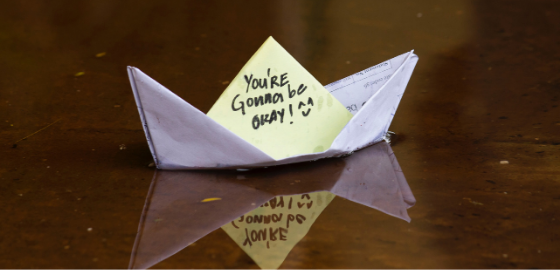
Every day in Children’s Mental Health Week (February 1-7) we’re sharing blogs from our counselling and youth work team at Children North East’s Young People’s Service.
Read yesterday’s about the Power of Boredom
18th May 2026
30th April 2026
How Little Minds in Mind Helped One Mum Feel Like Herself Again
16th April 2026
Masquer‑Aid: Building Confidence, Community and Self‑Advocacy
1st April 2026
Lockdown boredom is something lots of people say they’re experiencing, but it’s not necessarily a negative emotion as Fiona Wright, of our Young People’s Service counselling team, suggests:
Due to the current circumstances, it’s likely that there will be times when many of us fall into being bored. Whilst boredom can be negative, it can also have some surprising benefits – boredom can lead us to do altruistic things. Research has shown it can make us more likely to engage in prosocial behaviours like donating to charity or signing up for blood donations to help re-establish feelings of self-meaning.
 Boredom can help us become more goal-orientated. Researcher, Andreas Elpidorou states that:
“In the absence of boredom, one would remain trapped in unfulfilling situations and miss out on many emotionally, cognitively and socially rewarding experiences. Boredom is both a warning that we are not doing what we want to be doing and a ‘push’ that motivates us to switch goals and projects.”
Boredom can also lead us to become more creative.
UK psychologist Sandi Mann’s research involved asking people to do various boring tasks, then asking them to use their creative thinking. Those subjects who had the most boring task – reading the phone book – actually came up with the most interesting uses for plastic cups (their creative task and a standard test for divergent thinking).
So whilst we may feel we haven’t made the most of the time we have at the moment, the daydreams, ideas and reflections you may be experiencing now could be the beginnings of a process of change that can lead you to a happier and more fulfilled reality in the future.
Each time you think of something you would like to do, but can’t at the moment because of lockdown, such as going to the cinema with a friend, write it on a piece of paper and put it into an empty jar (you could use your creativity to decorate the jar). When social distancing is lifted, you’ll have lots of ideas for things to do in your Hopes and Wishes jar!
Or why not try keeping a record of this time? One of our counsellors, Paul Hedley says:
“Imagine it’s the year 2045 and you are with the people most important to you. They are curious about the Great Pandemic of 2020. You go to an old wooden trunk (other storage methods are available), blow the dust off, fiddle with the lock and produce an ancient looking piece of paper and read your own version of this historic time.
Your loved ones hang on your every word because they have never heard anything like it. Perhaps it tells them what your days were like, what coping methods you used, what your greatest fears were, how other people reacted to the situation or even what you had for dinner each day! Whatever you choose to write will be your unique personal version of a historical event. The opportunity to create history is not something that happens often so make sure you don’t miss the chance.
18th May 2026
30th April 2026
How Little Minds in Mind Helped One Mum Feel Like Herself Again
16th April 2026
Masquer‑Aid: Building Confidence, Community and Self‑Advocacy
1st April 2026