

18th May 2026

Our Poverty Proofing® service supports healthcare settings to minimise the impact of poverty on patient outcomes by listening to the experiences of their patients, staff and stakeholders on how their daily experiences intersect with poverty. But what does that mean in practice?
We interviewed Boris Landea, Administrator at Cruddas GP Park Surgery to share his experience of the process and how it has influenced his practice to view and tackle poverty differently.
I found the training really informative and eye-opening when we were talking about our catchment area.
What were your first thoughts about Poverty Proofing® when you found out it would be happening at Cruddas Park GP Surgery?
My first thought was it would be an amazing help for our practice just because of where our practice sits. It’s what our community needs. Poverty is the root of a lot of social care problems and we need better awareness. When the training happened I didn’t know what would be said so I loved the fact we were sitting in groups and chatting amongst ourselves. It was very interesting to see poverty awareness in both admin staff and GPs because we have different backgrounds, and how it is that we define poverty. It was good to work amongst people that weren’t just alike.
Phase one of the process is Poverty Proofing® training, which you have completed. How did you find the training and what stood out for you the most?
The training was just flowing, and you took questions all the time. I found the training really informative and eye-opening when we were talking about our catchment area and where we sit in the country. What was the most interesting is how poverty can come across. Poverty can be financial poverty, social poverty, and so there are different ways to look it. This is something I really discovered and was made aware of. Knowing that we can do something within the practice, the purpose being to see how we work and see how we can address poverty at first it feels like it’s going to be a mammoth task, because it’s another project on top of our work, but it’s a priority because it’s at the core of a lot of our patient’s problems.
It can always seem hard to see new projects come along, but Poverty Proofing® has been brought to us in a bitesize way.

Boris works at Cruddas Park GP Surgery in Newcastle’s West End
What role do you see playing in addressing health inequalities?
So, I think we can be an example for other practices because we’re taking on this project. We are lucky to have admin and healthcare staff who are on board so I think we can make a difference if we work through it together. The main thing is to be an example for other practices, something to aim for; to show that we can work in parallel, raising poverty awareness and the practiced work of a GP practice working alongside each other. It doesn’t have to be either or. Poverty is to be incorporated into our day-to-day life.
What would you say to another organisation who was considering undergoing the Poverty Proofing© process?
That they shouldn’t be scared of it. The training makes it seem like it can be achievable. It can always seem hard to see new projects come along, but Poverty Proofing® has been brought to us in a bitesize way. Don’t be scared, give it a go.
If you want to learn more about our Poverty Proofing Services for healthcare settings or how they can help you achieve your goals for inclusive, accessible healthcare, get in touch via our contact form.
18th May 2026

30th April 2026
How Little Minds in Mind Helped One Mum Feel Like Herself Again

16th April 2026
Masquer‑Aid: Building Confidence, Community and Self‑Advocacy

1st April 2026


We are standing with charities committed to ending poverty in urging the next Prime Minister to reassure low-income families they will receive sufficient support through a “national emergency”.
Alongside 70 charities and community organisations, Children North East have signed a letter calling on the two remaining Conservative Party leadership candidates to show “compassion and leadership” to working-age low-income families by making up the minimum expected £1,600 shortfall they face this winter.
Our letter states, “this situation cannot be allowed continue” and the prospective Conservative Party leader must ensure the social security system always provides enough to be able to afford the essentials. It also calls on Liz Truss and Rishi Sunak to commit to making debt deduction rates from benefits more affordable. MPs said these deductions pushed households into destitution and to depend on food banks.
“You were both senior members of a government that pledged to ensure that the most vulnerable and least well off get the support they need. It is only right that this be your top priority should you take office,” it ends.
If you would like to also take action and ask for more support during this national emergency, you can write to your MP.
Guidance on writing to your MP:
The full text of the letter is below:
Dear candidates
We believe the impact of the cost-of living crisis on low-income households is the gravest issue our country faces.
So far this year, nearly three quarters of low-income households[1] receiving Universal Credit or other means-tested benefits, many of them working families, have been forced to go without at least one essential. This means people having to skip meals or not being able to heat their homes properly.
Many of our organisations work directly with these families and are becoming overwhelmed, too often unable to provide the support so desperately needed.
This situation cannot be allowed to continue. As the prospective leaders of this country, we urge you to act now to demonstrate the compassion and leadership needed to tackle this issue head on.
We ask you both to pledge that, under your premiership, everyone who needs it will be properly supported when they hit hard times. This means ensuring that, at a minimum, the social security system always provides people with enough to be able to afford the essentials.
Low-income households need urgent reassurance now that they will receive sufficient support to weather the cost-of-living storm as it intensifies further this winter. This means committing to:
Ensuring that low-income households are provided with sufficient support to cope with the average £2,800 rise in the cost of living they face to April 2023. Given the £1,200 in core support committed so far to households on means tested benefits, this means this support should be at least doubled. It should also vary by need, with higher payments for households with higher needs, for instance families with children.
The most efficient way to provide this support would be through further payments through the social security system. Making debt deduction rates from benefits more affordable. Those subject to debt deductions face particularly high levels of hardship. This simple, low-cost action would enable people to keep more of their money and immediately relieve some of the financial pain they are enduring.
You were both senior members of a government that pledged to ensure that the most vulnerable and least well off get the support they need. It is only right that this be your top priority should you take office.
Yours Sincerely,
Joseph Rowntree Foundation
Save the Children UK
The Trussell Trust
The Children’s Society
The Trade Unions Congress
StepChange Debt Charity
Scope
Age UK
Shelter
Centre for Progressive Policy
St Mungo’s
Rethink Mental Illness
Macmillan Cancer Support
Mind
Oxfam GB
Action for Children
Centrepoint
Turn2Us
Young Women’s Trust
Royal National Institute of Blind People
Christians Against Poverty UK
FareShare UK
MS Society
Money Advice Trust
Trust for London
Motor Neurone Disease Association
Carers UK
Parkinsons UK
The Money and Mental Health Policy Institute
British Association of Social Workers
The Independent Food Aid Network
Policy in Practice
Lloyds Bank Foundation for England & Wales
Gingerbread
Generation Rent
Nacro
The Food Foundation
Disability Benefits Consortium
End Furniture Poverty UK
PlaceShapers
North East Child Poverty Commission
Children North East
The Bevan Foundation
The Poverty Alliance
The Association of Charitable Organisations
Sustain
One Parent Families Scotland
The Equality Trust
4in10 London’s Child Poverty Network
Communities that Work
The Mighty Creatives
Karbon Homes
Chartered Institute of Housing
National Federation of ALMOs
Poverty Truth Community
Home-Start UK
Family Fund
We Care Campaign
The Hygiene Bank
Glass Door Homeless Charity
Citizens Advice Scotland
Mencap
Transforming Lives for Good
Leonard Cheshire
Charity Finance Group
Women’s Regional Consortium Northern Ireland
Feeding Britain
UK Community Foundations
APLE Collective
Debt Justice
Greater Manchester Poverty Action
National Education Union
Just Fair
[1] Source: Joseph Rowntree Foundation (June 2022) Not heating, eating or meeting bills: managing a cost of living crisis on a low income. This surveyed ‘low-income’ households in the bottom 40% of incomes, including the approximately 5.6 million of these that claim means-tested benefits.
18th May 2026
30th April 2026
How Little Minds in Mind Helped One Mum Feel Like Herself Again
16th April 2026
Masquer‑Aid: Building Confidence, Community and Self‑Advocacy
1st April 2026

Every child should feel like they belong – especially at school. A school’s uniform can bring the school community together and create a shared identity. But when school uniforms are too expensive, this doesn’t happen.
In 2020, research from The Children’s Society revealed 1 in 8 families were having to cut back on essentials like food to afford uniforms for their children. 1 in 10 families were borrowing from friends or getting into debt to cover the costs.
Our research, completed with Child Poverty Action Group, shows the impact can be huge. Without the right uniform, children might not feel that they’re part of the school community. They can feel out of place or isolated, worrying about not wearing the right thing. They might be made fun of or even bullied. That’s why the new law on school uniforms that was passed in 2021 is so important.
The new law means affordability must be the top priority for schools when setting uniform policies. The Department for Education has also released statutory guidance about the issue – meaning all state-run primary and secondary schools must follow it.
To help your school implement the guidance, The Children’s Society, Child Poverty Action Group, and Children North East have joined forces to share some ideas and good practice from our research with schools. With some adjustments to policies and practices, schools can relieve the pressure of uniform costs on children and their families.
The key areas covered in the guide are:
We’ve also gathered ideas and suggestions from pupils and families about how uniform can be made more inclusive. We always want to hear from schools about they are tackling uniform policy, so if you have some ideas that have been impactful, why not share them with our team on Twitter.
18th May 2026
30th April 2026
How Little Minds in Mind Helped One Mum Feel Like Herself Again
16th April 2026
Masquer‑Aid: Building Confidence, Community and Self‑Advocacy
1st April 2026
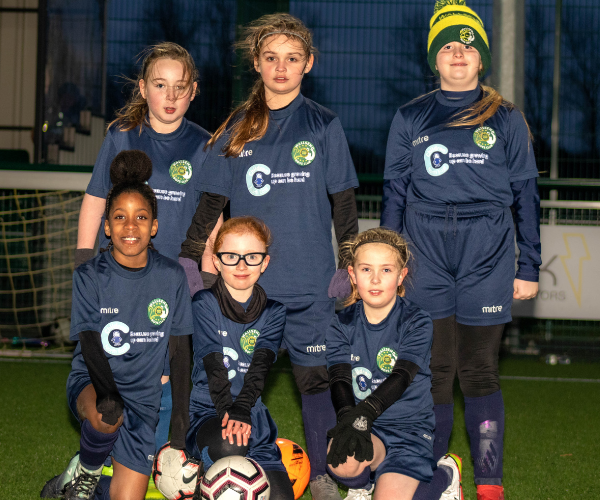 Kitted in their Children North East Kit, the Wallsend Boys Club Under 9’s Girls team warm up to take on an evening of training before their matches on Saturdays. The team has chosen to play wearing Children North East’s logo wanting to help raise awareness about the positive effects of our work! We went along to a session to see what being part of this football club means to the girls.
Manager, Crya Carne, explains that she works with girls from the age of three all the way up to women’s team. The Under 9 team all worked their way up from the development squad and wear the Children North East logo with pride.
‘Football helped them transition back to normal life after lockdown.’
 It was well documented that the pandemic took a toll on young people’s mental health and wellbeing. The Under 9s Squad Manager shared that after lockdown many children had lost interest in hobbies ‘but after being back playing football for a few weeks I could see their interest was back, they wanted to see people, make friends and go out and play football’. This is why it’s key to recognise the importance of keeping active and socialising!
‘You can see their confidence has improved!’
The team come together to train, improve and win matches! ‘In terms of football they’re all massively developing and really enjoying it. The younger ones can be quite shy but after a couple of weeks of just playing with the team they become really chatty!’. The team spirit was in the air all evening, highlighting the positive effect sports has both mentally and physically.
‘Everyone’s running round with their friends with has a smile on their face.’
 Sarah has been coaching the team for nearly a year, ‘My daughter plays and she classes these (the Under 9’s teammates) as her best friends’. The sense of community and friendship both on and off the pitch displays how much of an impact team sport has on young people. They train every Tuesday and Thursday for their Saturday matches, with more and more girls joining the team after lockdown! It provides the opportunity for friendship, staying active and perusing a passion.
Whilst the aim is good fun, ‘We’re (the coaches) quite competitive and so are the girls! ’ we can vouch that the girls always do their best and take home the trophy, just like the England squad, which we think is something to shout about.

18th May 2026
30th April 2026
How Little Minds in Mind Helped One Mum Feel Like Herself Again
16th April 2026
Masquer‑Aid: Building Confidence, Community and Self‑Advocacy
1st April 2026
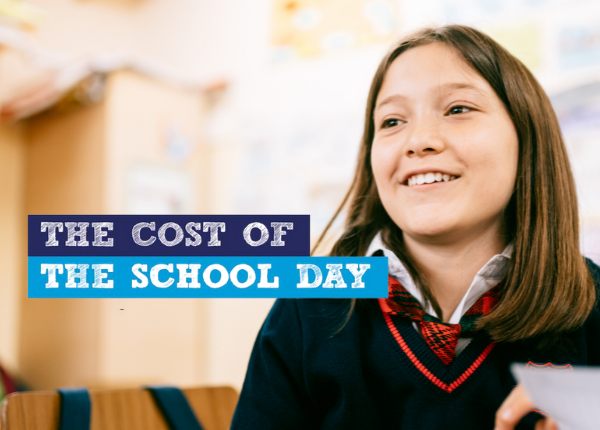 Children North East and Child Poverty Action Group are proud to announce we have been shortlisted for a national sector Award.
The Third Sector Awards have recognised the UK Cost of the School Day programme in the Charity Partnership of the Year category, which celebrates charities working together to effectively deliver services to beneficiaries and to reach new groups.
Since 2019, the UK Cost of the School Day programme has consulted with over 7,300 pupils directly and 7,000 indirectly to understand the impact of poverty on children’s school life and supported schools to remove barriers related to poverty for pupils and their families. A true collaboration, the success of the partnership is founded on a shared vision for alleviation of poverty through systemic change. Through publishing findings, sharing best practice and campaigning the programme has influenced long-term change within the sector.
Recognition on the Awards shortlist is a testament to the incredible work of the team involved, who have navigated the challenges of the pandemic to deliver scale of impact against the odds and responded to the rapidly changing needs of pupils, families and schools.
The shortlist includes partnerships doing incredible work across the UK towards diverse range of impacts, including Our Frontline, a project from Samaritans, Mind, Hospice UK and Shout supporting frontline workers whose mental health was impacted during the pandemic and the Help Through Hardship Helpline delivered by Citizens Advice and The Trussell Trust.
Leigh Elliott, Chief Executive of Children North East, comments, “We are delighted to see the UK Cost of the School Day programme recognised in these Awards. With the latest child poverty figures revealing an increase in the number of young people living below the poverty line, it is now more important than ever for organisations to address the invisible barriers they face every day. Child Poverty Action Group shares our vision for a society where children are protected from poverty and we are very proud our collaboration with them has been recognised.”
Alison Garnham, Chief Executive of Child Poverty Action Group comments, “The Awards shortlist has powerful examples of what successful partnerships in the charity sector can achieve. We are proud that our collaboration with Children North East on the UK Cost of the School Day project has been recognised as one such example. This project has allowed us to shine an important light on school-related costs and the consequences of living in poverty on a child’s experience of education. It is through joint work that our project has been able to have wide-ranging reach and impact.”
Winners of the Third Sector Awards will be announced on 30th September.
18th May 2026
30th April 2026
How Little Minds in Mind Helped One Mum Feel Like Herself Again
16th April 2026
Masquer‑Aid: Building Confidence, Community and Self‑Advocacy
1st April 2026

In our latest guest blog, Robyn Andrews shares what she gets up to in her role as Youth Worker, from peer mentor pairing to adventure playgrounds!
“There is a get stuck in mentality surrounded by an open and honest team.”
Arriving at Children North East is warm and inviting. In a new job there is usually a certain amount of anxiety which can make you feel slightly awkward and uncomfortable but I can honestly say that there is none of this at the organisation. Instead, there is a get stuck in mentality surrounded by an open and honest team.
My new role is that of Youth Worker and I’m involved in a variety of projects across the region which keeps my role engaging, varied and challenging – just the way I like it.
My first day in the job I was introduced to my new Youth Group, an inclusive space in Blyth where neurodiverse young people meet to have a safe and fun space to socialise. Since then, we have had some fantastic sessions and some even better trips! For me, this has been experiencing Children North East at its roots, a charity built from offering young people the chance to have a break and experience new things.
A highlight of my time here came a few weeks after my first session, we took a trip to Sunderland to watch Beauty and The Beast at the theatre – a first for many in the group! And more recently, to make the most of the fair weather, we have been to an adventure playground (A young person has since said to me “Can we not go every week?”).
“We are also empowering our young people to develop stronger relationships, form their identities and give them the opportunity to build confidence.”
Another large part of my role is a Short Breaks project where I work to match young people with SEND to peer mentors and map activities for these pairings to do across the North East. I am also privileged enough to mentor some of these young people myself; often the best part of my week is seeing the shining smile on their faces.
Youth Work is entirely focused around the participation of the young people we work with. It is essential that the projects we offer are tailored to the wants of these young people and using their thoughts and views shapes the way we as an organisation see the world. The value that our sessions add works both ways, not only is it a privilege to promote the voices of these young people but we are also empowering our young people to develop stronger relationships, form their identities and give them the opportunity to build the confidence they need to make impactful differences in our communities.
I’d like to round off by saying that working in the charity sector is a joy and giving back to place in which I live is fulfilling in ways that other roles just cannot compare. My advice to those who wish to pursue similar careers or join us would be to work hard and get involved in as much as you can. The more experience you can get of working with people and young people the better, you are never sure what the day will throw at you so the more practice you have dealing with the unexpected will serve you well!
But most importantly: if you are passionate, excited, respectful, and most of all kind… I can assure you, you will do just fine!
18th May 2026
30th April 2026
How Little Minds in Mind Helped One Mum Feel Like Herself Again
16th April 2026
Masquer‑Aid: Building Confidence, Community and Self‑Advocacy
1st April 2026