

18th May 2026
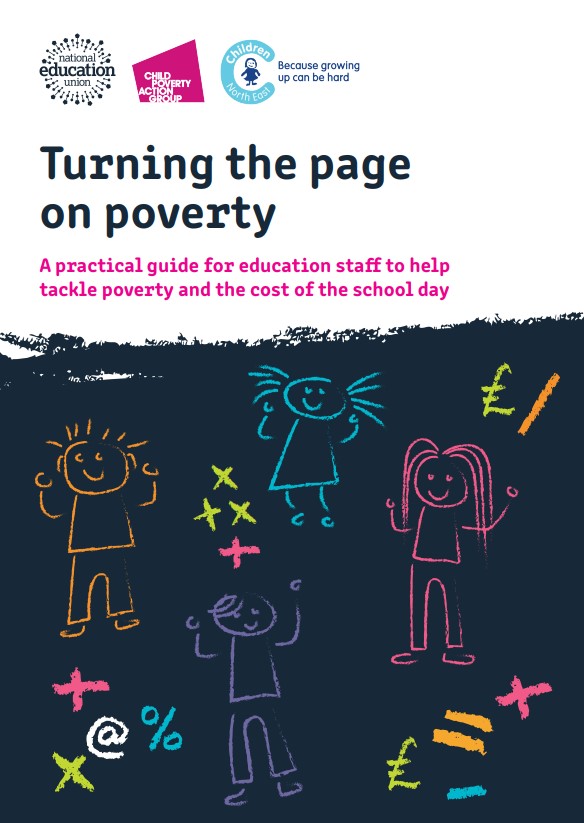
We’ve partnered with Child Poverty Action Group and the National Education Union to publish a new resource for schools, aimed at helping teachers and school staff tackle poverty.
Children North East and Child Poverty Action Group developed the resource, ‘Turning the page on poverty’, based on our years of experience working directly with schools to reduce financial barriers to learning. This year we celebrate ten years of our unique Poverty Proofing the School Day project which creates a level playing field for pupils in the classroom.
 Published in the context of increasing levels of hardship for families, the toolkit highlights the crucial role schools can play to support struggling families. The pandemic has hit household finances hard, particularly families with children, and schools are already recognising the need to support pupils in poverty more than ever.
‘Turning the page on poverty’ is a practical guide for staff, with information on poverty and ideas for how to reduce the costs of the school day. It includes sections on a range of topics related to child poverty in the classroom, including:
 Alongside the toolkit, we’ll be running training workshops with CPAG for NEU members and school staff in England and Wales to help increase awareness of poverty in schools and provide practical ideas and examples of what can be done to improve the school day for children and families in low income households.
Luke Bramhall, Poverty Proofing and Participation Service Manager for Children North East, said:
Since the formation of Poverty Proofing the School Day nearly 10 years ago we have seen the richness and the power in the voice of pupils in informing school staff on what the challenges within the school day are for those caught in the grip of poverty. We are proud to present this resource for school staff as one of the mechanisms of sharing the experiences of children and young people and can see its value in supporting schools in meeting the needs of children who may struggle to access education as a result of the poverty they face.
Alison Garnham, Chief Executive of Child Poverty Action Group, added:
“Our Cost of the School Day programme has been running since 2014, and we know that school staff often go above and beyond to support children and families struggling on low incomes. Our new toolkit aims to help teachers and staff with structured practical advice and recommendations informed by our work with school communities across the country.
By removing financial barriers to learning, schools can help all children access opportunities to learn and participate. We hope NEU members and school staff across the UK will find this resource useful as they continue their valuable work during this difficult time.
But poverty doesn’t stop at the school door. While schools can and do make a difference in their community, it is up to the Government to take action to reduce child poverty in the UK.”
Dr Mary Bousted, Joint General Secretary of the National Education Union, said:
“As a result of the pandemic, we’re facing unprecedented new levels of hardship. This practical resource draws on ideas that schools have developed and tested, before and during Covid 19, in terms of talking about poverty, understanding the stigma and helping families to access other local services.
“In working with Children North East and Child Poverty Action Group, we want to recruit more schools to this approach of thinking reflectively about how poverty affects the school day, how children feel and the attitudes we hold about poverty. It’s time to re-think a great deal about education policy in England if we want to build a fairer system after Covid and we think this resource is timely.
“By sharing good practice between schools, we can build capacity to make a difference and this resource is built on what schools are doing. We must ‘turn the page’ on poverty. Alongside schools’ determined efforts, the Government needs to commit to doing everything that is necessary on income support to ensure children aren’t growing up in poverty. We have to tackle the drastic income inequality in the UK and eradicate the gap in incomes and rise in poverty rather than asking schools to ‘close the gap’.”
18th May 2026

30th April 2026
How Little Minds in Mind Helped One Mum Feel Like Herself Again

16th April 2026
Masquer‑Aid: Building Confidence, Community and Self‑Advocacy

1st April 2026
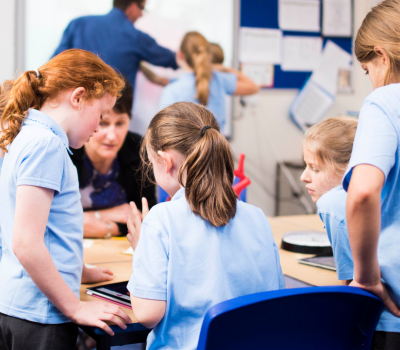
Today we are releasing our ‘Turning the Page on Poverty’ resource, co-produced with Child Poverty Action Group (CPAG) and the National Education Union (NEU). The resource, aimed at helping teachers and school staff tackle poverty in the classroom, has been developed based on our years of experience working directly with schools to remove barriers to learning through our Poverty Proofing the School Day and Cost of the School Day programmes. Francesca Hogg, from our Poverty Proofing and Participation Service, tells us more about this fantastic resource.

This resource comes at a time when, as a result of the pandemic and a cost of living crisis, households have experienced a further reduction in finances, hitting families with children hardest. Some of these families will have been pulled deeper into poverty, whilst some will be experiencing it for the first time.
The ripple effect of poverty means it inevitably impacts school life. It means struggling with school-related costs such as uniform, resources and school trips but it also means poorer health, social and educational outcomes all of which impact children’s ability to fully participate in school life.
Each school is different with unique challenges and opportunities, so a ‘one size fits all’ approach to tackling poverty in the classroom doesn’t work. However, using our knowledge of poverty and the lessons we learned through our work in schools, this resource gives schools practical guidance and information on the drivers and impact of poverty and provides approaches teachers and school staff can adapt to support families living in poverty.
By no means do we think schools can solve the inequalities in society, but by challenging the policies and practices within our schools, they can reflect the way we want society to be. We know there are lots of examples of schools having support in place for pupils and their families, but to really understand what support is needed in a local context, we must put children at the centre of decision making and policies within our schools.
We need to understand what the school day looks like for a child growing up in poverty and how we can create equitable opportunities for all pupils.
It is through our collective knowledge and experience of working with schools and children living in poverty, we hope this resource will equip teachers and school staff with the practical tools needed to drive forward the conversation on poverty within schools and address the challenges poverty presents.
18th May 2026
30th April 2026
How Little Minds in Mind Helped One Mum Feel Like Herself Again
16th April 2026
Masquer‑Aid: Building Confidence, Community and Self‑Advocacy
1st April 2026
Throughout the Covid-19 pandemic we’ve heard commentators talking about how ‘we’re not all in the same boat’. We may all be facing the same Covid-19 virus, but we’re not all experiencing its impact in the same way.
For many, Covid-19 has been the equivalent of the iceberg facing the Titanic. Unavoidably destructive – but you might have some chance of clinging on to survival and rescue if you’ve got the resources to do so. For others, they have no chance.
Passengers on board Titanic were not all equal – they were classed as first, second and third. And their class went on to have a direct impact on their chances of survival.
In the same way, families in our region have been – and will continue to be – affected differently by the impacts of Covid-19.
 On Titanic, the first class passengers board the lifeboats, those who don’t are provided with lifejackets – many of them go on to survive.
Some second class passengers manage, through determination and luck to get on to the lifeboats, but in the main they are given lifejackets and told to get on with it and survive – some are picked up by rescue ships and go on to live their lives.
And then there are the third class passengers – many are locked below deck, unable to escape to safety, those who do manage to get up onto deck find all the lifeboats have gone, there are no lifejackets left and they are just told to jump and hang on to what they can – many don’t survive while waiting on the rescue ships.
The impact of Covid-19 on the poor is much like the third class passenger – no lifeboats, no lifejackets and no rescue boats and the impact is so severe it will last their entire lives.
There is no getting away from this. The iceberg has struck, the damage is done. Already disadvantaged families have been affected the most, and will continue to feel the impacts the most – through loss of incomes, children falling behind with learning, worsening mental and physical health and more.
In 2010 the Child Poverty Act was passed with cross party support to end Child Poverty by 2020.
It is now 2021 and it has not happened. Instead, the picture is worsening. We were already facing a huge crisis, and Covid-19 has deepened that.
The facts are stark and grim:
• The North East has the second highest rate of child poverty in the UK at 35 per cent (set to rise).
• The North East saw the UK’s biggest increase in child poverty rising from 26 per cent to 35 per cent.
• All 12 North East councils are included in the 20 UK local authority areas which saw the highest increases in child poverty (with Middlesbrough and Newcastle seeing the biggest increases).
• Of the 20 UK Parliamentary constituencies which saw the highest increase in child poverty, more than half are in the North East.
• In the most deprived areas, boys can expect to live 19 fewer years of their lives in ‘good’ health, and girls 20 fewer years, than children in the least deprived areas.
• The poorest groups in society are dying almost a decade earlier than the richest – this has been exacerbated by welfare cuts and the rising cost of living (Imperial College London).
• Due to Covid there has been a 4.5 per cent fall in median household income between May 2019 and May 2020 – this is the largest yearly fall since the 1970s.
• It is estimated that another 300,000 children will have been pushed into poverty through the pandemic.
• Children who have lived in persistent poverty during their first seven years have cognitive development scores on average 20 per cent below those of children who have never experienced poverty.
• Work does not provide a guaranteed route out of poverty in the UK. Seventy two per cent of children growing up in poverty live in a household where at least one person works.
• In 2015, 33 per cent of children receiving free school meals obtained five or more good GCSEs, compared with 61 per cent of other children.
• Of the 35 per cent of children living in poverty in the North East, 55 per cent are aged 0-5 years.
There is much good work already underway but we must do more – and by working together, we can make much more of an impact.
Collectively, we must continue to campaign to address the impact of poverty on children and families.
We must continue with the research that leads to evidence of what works and what doesn’t work, and lobby for policy change on the back of that. We must continue to push for real increases in funding, for longer term solutions, for recognition at the very highest level that this is a real and serious issue that isn’t going to go away.
Alongside this, and at a local level, we have families in real need, right now. As a community, we can work together to make sure babies, children and families can get the resources and support they need. By working in partnership with local authorities, other charities, schools, community organisations, we can do our best to ensure that children in need don’t become invisible or fall through the net.
At Children North East, our everyday work involves a lot of immediate and on-the-ground work – such as food parcels, support for expectant parents, domestic abuse support, resources for schools, poverty proofing in schools, and more.
The Supporting Children and Families theme of work in the ARC North East and North Cumbria gives us the ideal vehicle to bring together our collective local knowledge, experiences, expertise and ideas.
Working together will give us the very best chance of tackling these significant challenges facing our local communities and the very best chance of supporting babies and children in our region.
 This blog was originally written by Michele Deans for the NIHR’s Applied Research Collaboration (ARC) for the North East and North Cumbria where Michele is Deputy Lead for their Children and Families Theme. ARC is a partnership that brings together six regional universities, the NHS, health and social care providers, local authorities, the voluntary sector, community groups, members of the public and others.
18th May 2026
30th April 2026
How Little Minds in Mind Helped One Mum Feel Like Herself Again
16th April 2026
Masquer‑Aid: Building Confidence, Community and Self‑Advocacy
1st April 2026
Our Computers for Kids campaign, launched last year to help more children and young people get online, has received its biggest boost to date thanks to a £30,000 donation by software company, Sage.
And it’s hoped this major cash injection will spur more of the region’s leading businesses to follow suit and donate to help disadvantaged youngsters access technology.
 According to analysis from the Northern Powerhouse Partnership, at least 55,000 families in the North East do not have access to a laptop, tablet or desktop computer. Digital exclusion can lead to less access to education and jobs and social isolation in later life.
Each £200 funds a digital device, connectivity and distribution for a child or young person. Sage is calling on other businesses to help raise £100,000 as this would provide the region’s children with 500 new, data-enabled laptops; a significant contribution towards ending digital poverty in the North East.
Any individuals or companies wishing to donate can do so by clicking the box below.
Paul Struthers, MD UKI, Sage, said: “The pandemic has accelerated use of technology in schools, although in turn it has exacerbated the impact of digital exclusion of some children.
“This is not a problem that will diminish when schools reopen as normal; it needs to be part of a vision where all can benefit from the huge advantages access to digital can bring to education.
“We’re delighted that our donation will have such a positive impact in this region. But we are also asking other businesses to follow suit and donate what they can to support families in their communities that need it most.”
Leigh Elliott, Chief Executive of Children North East, said: “Children North East is liaising closely with schools across the region who have been working tirelessly to identify those pupils most significantly impacted by Covid-19. Our charity will ensure those children get access to all the digital technology and connectivity they need to engage in their schoolwork and activities.
“This is not just a short-term issue, it is more important than ever to look at a long-term sustainable approach in ensuring all children and young people, especially those suffering the effects of poverty, get access to online learning.
“Sage has provided our campaign with a massive boost, our biggest donation to date, in purchasing new devices and we are delighted to be able to offer more businesses the chance to get behind this at such a difficult time for many families.”
The £30,000 Sage donation will be funnelled to the North of Tyne Combined Authority area, where the company’s new global head office will be based when it opens at Cobalt Business Park. This builds on a £20k donation the company made in 2020 to the combined authority’s Digital Inclusion programme.
18th May 2026
30th April 2026
How Little Minds in Mind Helped One Mum Feel Like Herself Again
16th April 2026
Masquer‑Aid: Building Confidence, Community and Self‑Advocacy
1st April 2026
The simple fact that we can mark Children’s Mental Health Week now is important to me for many different reasons writes Rhoda, counsellor with our Young People’s Service.
Here in 2021 it feels like we really are getting to a place where mental health can be spoken about openly. I know we don’t need this week to tell you to seek counselling because so many of you are doing it already. We have a generation of children and young people who feel it’s kind of normal to ask for help. I know this because I’ve seen it change.
 Just ten years ago when I was finishing my training to be a counsellor, we were starting to decide if the Young People’s Service here at Children North East could have a counselling service. Would people even attend? Would anyone want it to be part of a normal youth centre? And the answer was overwhelmingly yes, young people wanted that far more than they wanted to feel like they were ‘mad’ if they had to go to a cold, white, doctor’s office. Back then I went to schools to help people and it was only just starting to be normal to have a counsellor in school. Teachers’ attitudes have changed, parents’ attitudes have changed.
This week has the important role of letting us speak to everyone about mental health, not just the people who need it right now. We all have mental health, it can be something that is feeling healthy or not. We can have bad days or sad days or days we are quite worried and people will say that now.
Many adults worry that young people are using this language inappropriately and sometimes that can be true. But for the most part, I am just happy that someone will say how they feel, will notice if their child hasn’t been coming out of their room as much or there’s been a change in someone. We notice and we ask if we can help. The advice isn’t always perfect and the help can’t always be there quickly but it is growing into something normal.
I feel how important this is because the main reason I do what I do comes from the time in my life when all my friends were ignored and labelled and passed over. I stood in a phone box with my best friend while they rang Childline because that was the only thing we knew to do. We had nowhere to go, we had no message services to reach a worker, there was no one in school to trust. Family members were too stressed or would have blamed us and it really felt no one cared. I don’t want anyone to feel like that again.
And I hope that just seeing a simple post about mental health tells you, you are not alone.
READ more about our Young People’s Service counselling service here
18th May 2026
30th April 2026
How Little Minds in Mind Helped One Mum Feel Like Herself Again
16th April 2026
Masquer‑Aid: Building Confidence, Community and Self‑Advocacy
1st April 2026
As well as it being Children’s Mental Health Week, today has also been designated Time to Talk Day by the mental health organisation, Time to Change. It’s a day when we’re all encouraged to take the opportunity to check in with each other and talk about how we’re feeling.

We know that the more conversations we have, the more myths we can bust and barriers we can break down, helping to end the isolation, shame and worthlessness that too many of us with mental health problems are made to feel – Time to Talk
There’s a whole day of online activities available to join on the Time to Talk Day website that anyone can do from home, creating a space to come together and be inspired to start conversations about mental health.
From 10am young people will be able to watch an event called Young Champions – tips for talking about mental health and from 3pm you can join in with a ‘laughter yoga’ class. Then there’s a Bollywood dance class from 5pm and from 6pm, everyone’s favourite kitchen disco queen Sophie Ellis Bextor reads a book called Ruby’s Worries by author and illustrator Tom Percival. Tune in to @sophieellisbextor on Instagram to hear her read or watch via the Time to Talk web page here.
18th May 2026
30th April 2026
How Little Minds in Mind Helped One Mum Feel Like Herself Again
16th April 2026
Masquer‑Aid: Building Confidence, Community and Self‑Advocacy
1st April 2026