

18th May 2026
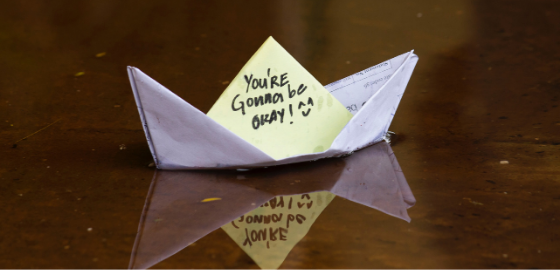
Stop beating yourself up for not handling this pandemic right says Catriona Port, a counsellor with our Young People’s Service. And whilst creativity is great, perhaps on reflection, those origami swans can wait…
 A lot of people are giving themselves a hard time right now.
“Why am I not coping better?”
“I have a lot to be grateful for, I shouldn’t be feeling low.”
“I should be doing something productive. Why haven’t I made 59 origami swans before 10am?”
“People have it much worse than me.”
But let me reassure you that right now you are experiencing a change in life that came suddenly and unexpectedly. Like all change, this brings loss – loss of connection, freedom and even safety – the list goes on.
We are grieving for what we have lost. Even if there are positive changes, we should not ignore the losses which have brought pain and struggle.
Can you imagine saying any of the things above to someone else who was, say, grieving the loss of a loved one?
Then why say it to yourself? Even with the knowledge that this will pass eventually, we have had to change everything about the way we connect with others and function – we have lost things we love. It is exhausting.
And yet somehow, you marvellous human being, you have found a way to carry on through all of it. So keep going, whatever way you can. Instead of telling yourself off for not being able to meet unrealistic goals, praise yourself for how much you have adapted to.
Give yourself breaks, rest, say no to things that are too much right now, say yes to things that make you feel good and do what you need to feel connected to others. Telling someone off who is struggling is about as much use as an origami swan – so do NOT belittle yourself.
You are doing an incredible job and we ALL need kindness right now.
Every day in Children’s Mental Health Week (February 1-7) we’re sharing blogs from our counselling and youth work team at Children North East’s Young People’s Service.
Read yesterday’s about the Power of Boredom
18th May 2026

30th April 2026
How Little Minds in Mind Helped One Mum Feel Like Herself Again

16th April 2026
Masquer‑Aid: Building Confidence, Community and Self‑Advocacy

1st April 2026
Lockdown boredom is something lots of people say they’re experiencing, but it’s not necessarily a negative emotion as Fiona Wright, of our Young People’s Service counselling team, suggests:
Due to the current circumstances, it’s likely that there will be times when many of us fall into being bored. Whilst boredom can be negative, it can also have some surprising benefits – boredom can lead us to do altruistic things. Research has shown it can make us more likely to engage in prosocial behaviours like donating to charity or signing up for blood donations to help re-establish feelings of self-meaning.
 Boredom can help us become more goal-orientated. Researcher, Andreas Elpidorou states that:
“In the absence of boredom, one would remain trapped in unfulfilling situations and miss out on many emotionally, cognitively and socially rewarding experiences. Boredom is both a warning that we are not doing what we want to be doing and a ‘push’ that motivates us to switch goals and projects.”
Boredom can also lead us to become more creative.
UK psychologist Sandi Mann’s research involved asking people to do various boring tasks, then asking them to use their creative thinking. Those subjects who had the most boring task – reading the phone book – actually came up with the most interesting uses for plastic cups (their creative task and a standard test for divergent thinking).
So whilst we may feel we haven’t made the most of the time we have at the moment, the daydreams, ideas and reflections you may be experiencing now could be the beginnings of a process of change that can lead you to a happier and more fulfilled reality in the future.
Each time you think of something you would like to do, but can’t at the moment because of lockdown, such as going to the cinema with a friend, write it on a piece of paper and put it into an empty jar (you could use your creativity to decorate the jar). When social distancing is lifted, you’ll have lots of ideas for things to do in your Hopes and Wishes jar!
Or why not try keeping a record of this time? One of our counsellors, Paul Hedley says:
“Imagine it’s the year 2045 and you are with the people most important to you. They are curious about the Great Pandemic of 2020. You go to an old wooden trunk (other storage methods are available), blow the dust off, fiddle with the lock and produce an ancient looking piece of paper and read your own version of this historic time.
Your loved ones hang on your every word because they have never heard anything like it. Perhaps it tells them what your days were like, what coping methods you used, what your greatest fears were, how other people reacted to the situation or even what you had for dinner each day! Whatever you choose to write will be your unique personal version of a historical event. The opportunity to create history is not something that happens often so make sure you don’t miss the chance.
18th May 2026
30th April 2026
How Little Minds in Mind Helped One Mum Feel Like Herself Again
16th April 2026
Masquer‑Aid: Building Confidence, Community and Self‑Advocacy
1st April 2026
February 1st marks the start of Children’s Mental Health Week 2021.
Organised by the charity Place2Be, the awareness week aims to shine a spotlight on the importance of children and young people’s psychological wellbeing.
This year’s theme is Express Yourself and it’s all about finding ways to share feelings, thoughts, or ideas, through creativity. This could be through art, music, writing and poetry, dance and drama, photography and film, and doing activities that make you feel good.
To kick off the week, we’d like to share this blog by Liz Hawksworth, a counsellor with our fabulous Young People’s Service, all about the life-enhancing power of nature and creativity. Each day this week, we’ll publish a different blog by staff from our Young People’s Service, aimed at helping young people through the current lockdown, so keep checking in. Thank you for reading!
“Engagement with the natural world and the creative arts stimulates the brain and brings a sense of lift and wonder.”
So says Dr Bill Merrington – not a surprising fact to any of us, I’m sure. He notes that during times of war, disaster and trauma, people’s interest in nature heightened. I wonder how many of us find our awareness of nature’s beauty magnified through lockdown? The moon rising, the sounds of the birds, the splendour of a sunrise, the wonder of the changing seasons.
Stella Adler observed:
“Life beats down and crushes the soul and art reminds you that you have one.”
Creativity – our own and connecting with the creativity of others – can be nourishment for our souls. I wonder how often we are tapping into such life-enhancing channels through these unprecedented days?

I love ‘Hold’, created during a previous lockdown, by sculptor, Sir Antony Gormley, a miniature version of an existing piece of his work. In a BBC interview, he said: “Most of us live our lives in ridiculous obligation to a machine that is always telling us to do more, have more, go to more places, make more money. This is a wonderful time in which those imperatives are loosened. And we have to ask ourselves, ‘What do we care about?’, ‘What do we value?’, ‘What do we love?’
Creativity, of a myriad of medium, can speak into the core of our beings, giving expression to our thoughts and feelings, perhaps sitting unacknowledged deep within, the flow that can come as we draw, paint, use textiles, garden, make music, appreciate creativity exprssed by others – a multitude of ways to engage with the creative parts of who we are.
And so, with research increasingly demonstrating that in engaging with nature we bring a balancing effect to our mental wellbeing and creativity, offering potential (as Picasso said) to ‘wash from the soul the dust of everyday life’, let’s remember to take some time to pause, to breathe, to notice, to create, to appreciate, to wonder and to give opportunity for our souls to be replenished.

Allotment flowers by Gemma, young person attending one of our drop-ins
* Find out more about our Young People’s counselling service.
18th May 2026
30th April 2026
How Little Minds in Mind Helped One Mum Feel Like Herself Again
16th April 2026
Masquer‑Aid: Building Confidence, Community and Self‑Advocacy
1st April 2026

During the first lockdown in 2020, alongside Child Poverty Action Group (CPAG), we conducted surveys and heard from thousands of parents, children and young people in the UK about their experience of learning in lockdown. This research was incredibly useful and helped shape recommendations to schools, councils and government about how best to support families.
We have now launched new surveys asking families about their experience this year. If you’re a parent or carer with school-aged children, we would love to hear from you and your children. Please complete our surveys to let us know what has been working well for you this year and what could be improved.

18th May 2026
30th April 2026
How Little Minds in Mind Helped One Mum Feel Like Herself Again
16th April 2026
Masquer‑Aid: Building Confidence, Community and Self‑Advocacy
1st April 2026
Staff and students from Durham University have raised more than £1,300 for Children North East and Chester-le-Street’s REfUSE thanks to their Christmas Wish Tree appeal.
Each festive season the University’s Student Union chooses the causes they wish to support and our charity was one of those selected.

Durham University’s Wish Tree
The Christmas Wish Tree campaign was however a little different this time due to Covid-19. Liz Waller, Director of University Library and Collections, University Librarian, said:
We are unbelievably grateful to everyone who contributed to our Christmas Wish Tree fundraising efforts, particularly during these uncertain times.
“In previous years, we have asked our University community to purchase specific items from the charities’ wish lists, wrap them and return them to our Bill Bryson Library to put under the tree. With the pandemic forcing us to change our approach and ask for monetary donations we were concerned about what people might contribute. The result though is amazing and we are thrilled with the total donated to each of our chosen charities.”

Donations go to a variety of projects, including our craft resource packs for children
Our Chief Executive, Leigh Elliott, said: “We are so grateful to the staff and students at Durham University for this fantastic donation. Many of the families we work with will be experiencing real problems under this current lockdown and this will enable us to continue to provide food parcels, resource packs and other help to our beneficiaries. Thank you to everyone who took part.”
Nikki Dravers, founder of REfUSE, a surplus food redistribution charity that also runs a community cafe, added: “Our hearts broke reading some of the messages we received this Christmas, hearing just how much people are struggling to even put a meal on the table for their families.”

REfUSE redistribute surplus food that would otherwise be wasted
18th May 2026
30th April 2026
How Little Minds in Mind Helped One Mum Feel Like Herself Again
16th April 2026
Masquer‑Aid: Building Confidence, Community and Self‑Advocacy
1st April 2026
Thanks to funding from the Co-op Foundation, we’re setting up a unique project to help primary pupils settle into secondary school.
We’re going to use the £67,885 funding to set up an innovative peer mentoring programme within Burnside Business and Enterprise College, North Tyneside which is expected to benefit more than 1,000 young people over two years.

The Co-op Foundation awarded the grant as part of a £3m extension to its #iwill Fund, designed to empower young people to improve spaces, wellbeing and skills.
Luke Bramhall, our School Research and Delivery Manager, said: “We’re delighted to have received this funding and to be embarking on this work with Burnside Business and Enterprise College and its feeder primary schools.
“The step up to secondary education is an important stage in young people’s lives and we hope this project will lead to a smoother transition for primary pupils and provide secondary peer mentors with valuable life skills, alongside inspiring them in social action.”
Charlotte Jenkins, Deputy Headteacher at Burnside Business and Enterprise College, added:
“We are excited to continue our work with Children North East and for some years now we have been working towards ensuring students are ready for their arrival at secondary school and that they feel they can contribute positively within the school and wider community.
“This unique project will allow those younger students to benefit from mentorship and guidance from our sixth form peer mentors who consistently prove how excellent they are as role models. It will be great to see them working together and hopefully increasing engagement in extracurricular activities as well as their learning in school.”
The #iwill Fund is a £50 million joint investment from the National Lottery Community Fund, using National Lottery funding, and the Department for Digital, Culture, Media and Sport (DCMS) to support young people to access high quality social action opportunities. The Co-op Foundation acts as a match funder.
Co-op Foundation is the Co-op’s charity. It helps people challenge inequality and co-operate for change so they can share a fairer future.Subscribe to the Co-op Foundation blog to find out first when funding applications open: www.coopfoundation.org.uk/blog.

18th May 2026
30th April 2026
How Little Minds in Mind Helped One Mum Feel Like Herself Again
16th April 2026
Masquer‑Aid: Building Confidence, Community and Self‑Advocacy
1st April 2026