

18th May 2026
Since 1891, Children North East have worked to make a difference to the lives of babies, children, and young people throughout the North East. By providing life-changing services, support and initiatives we can give families the tools they need to thrive.
This year we’ve seen some incredible results of our team’s hard work – providing support to those who most need our help. Some of our favourite highlights include our Annual Beach Trip, Family Fun Days at Cowgate, the iconic Great North Run and our 10 Years of Poverty Proofing® Conference! We’ve seen babies, children and young people thrive over the year, making friends at our Baby & Toddler Groups and Youth Groups at Cowgate, taking cultural trips with the National Trust, building confidence and using their voices to inform Poverty Proofing work, and even building their own Pizza Oven!
We’re pleased to share our 2023/24 Impact Report, providing a detailed look in to our work over the past year.

Some of our favourite moments of the year!
It has been a year marked by challenges and uncertainty for babies, children, young people and their families. Their opportunity for happiness and health continues to be deeply affected by the difficulties faced growing up, living in poverty and the impact of policy failure; both in the North East region and across the UK.
Responding to these pressures, Children North East has strengthened its advocacy efforts, amplifying the voices of the children and families who need real systemic change to thrive. This has included calling for key policy changes in the lead up to North East Mayoral and General elections, and strengthening our advocacy networks year round.
We are incredibly proud of everything our teams have achieved, and more so of the babies, children, young people and families we have worked with who have thrived and continue to go from strength to strength.
Some key stats from the year…
4,187 individuals provided with support
980 families provided with support
2,956 counselling sessions delivered
3,068 professionals trained
As we continue to advance our 2021-2026 five-year strategy, we are proud to continue our progress towards its goals of increasing impact, expanding our reach and fostering sustainability and growth. As we’re sure you’ll agree, this has been an impactful year for Children North East but our work isn’t done yet. We won’t stop until every baby, child, and young person has the happy, healthy start in life they deserve.
Your support means that we can be there when we are needed most.
If you’re able to donate, fundraise, become a corporate sponsor, or support us in some other way, we’d be extremely grateful.
Or for further information on our work and projects, get in touch.
18th May 2026

30th April 2026
How Little Minds in Mind Helped One Mum Feel Like Herself Again

16th April 2026
Masquer‑Aid: Building Confidence, Community and Self‑Advocacy

1st April 2026

Unfortunately, challenges faced by families don’t go away during the festive season which is why our teams, supporters and volunteers work year round to deliver our life-changing services.
This year, we were delighted to welcome a very special guest and our long-time Patron, Tim Healy, for a visit to our Boogie Bairns session at Cowgate. Tim has been a supporter of Children North East for close to 30 years and our cause has always been close to his heart. He continues to work with us to create real change in our region for babies, children and young people.
This was an opportunity for him to connect with our Communities Team to learn more about the incredible work they do with children, young people and families at our Cowgate Hub and speak with our CEO, Leigh Elliott, about our exciting plans for 2025.
He didn’t just come for a cuppa and a catch up though! Tim spent quality time with some of the children, parents, carers and grandparents that use our services, rolling up his sleeves and helping run the Boogie Bairns alongside our Families Coordinator, Alex Kirkpatrick, and put his acting skills to good use reading a story to the children. His visit truly brightened everyone’s day and meant so much to those involved.
See some of our favourite snaps from the day!


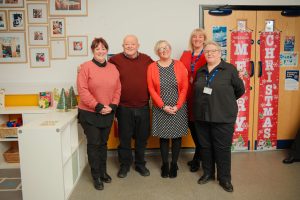


Our Cowgate centre runs sessions every weekday, and delivers special events like our Family Fun Days and Beach Trip throughout the year, as well as offering space to partner programs allowing the community to access much needed services on their doorstep. With our Cafe Hope serving hot meals and drinks as well, this truly is a hub at the heart of the community for all.
However, this and all the work we do can only be made possible with the generosity from our supporters, whether it’s one off donations or fundraising events, every penny raised helps up deliver life-changing services to babies, children and young people in the North East. Currently, our teams are seeing some of the most challenging times in memory, with services providing life-changing support such as mental health interventions, help for families in crisis and access to support groups all oversubscribed; whilst traditional funding to meet the demand is scarcer than ever. This Christmas, consider donating to our Be a Lifeline campaign, where you’re not just giving a gift for December – you’re providing a future filled with hope.
18th May 2026
30th April 2026
How Little Minds in Mind Helped One Mum Feel Like Herself Again
16th April 2026
Masquer‑Aid: Building Confidence, Community and Self‑Advocacy
1st April 2026

Terms & Conditions:
Please note, any photos submitted to Children North East may be used for future marketing materials by the charity.
By sharing your details with Children North East, you are agreeing to usage per our privacy policy
18th May 2026
30th April 2026
How Little Minds in Mind Helped One Mum Feel Like Herself Again
16th April 2026
Masquer‑Aid: Building Confidence, Community and Self‑Advocacy
1st April 2026
At Children North East’s recent conference celebrating ten years of our cutting-edge Poverty Proofing® work, we heard from leaders from health, culture and education systems describing their journey of change to tackle poverty in their communities.

The evidence of the links between poverty and poor health outcomes is overwhelming.
We see twice as many incidences of respiratory illnesses for children living in fuel poverty (Institute of Health Equity), the most deprived 10% of children make double the number of A&E visits than the least deprived (The King’s Fund), fewer children living in poverty hit developmental milestones around speech, language, potty training and school readiness (Save the Children). We see soaring childhood obesity (Nuffield Trust), declining dental health (Queen Mary University of London) and an epidemic of mental health issues among children and young people (Mental Health Foundation).
Poor health outcomes continue for a lifetime, and the cost to the public purse is staggering. In diabetes care alone, it is estimated that over £6bn is spent annually on complications that could be prevented with the right care in place. The human cost is worse; hundreds of thousands of children denied the chance to grow up happy, healthy and able to thrive.
Poverty strips families of agency; the ability to plan, to maintain a routine, to make healthy meals, to make and keep appointments, buy the right equipment to meet their children’s basic needs, to budget, to keep their house safe and warm. Under the weight of day-to-day survival, families struggle to act on concerns until things reach crisis point.
The same could be said of public services, which have been surviving on poverty rations for so long. Not being able to invest in more diagnostic equipment that could bring down waiting lists. The regular disruption of patching up buildings no longer fit for purpose. The inability to plan budgets beyond the single year. The lack of capacity to offer routine appointments when they are due. Ever increasing thresholds and the inability to intervene before things reach crisis point.
The intersection is catastrophic for struggling families, who are unable to make appointments with GPs and facing long waits for assessments and treatment, from neuro divergence, to mental health, to surgery for debilitating conditions. Those with the agency and resources can make lifestyle choices to maintain their wellbeing, fight the system to get the care they need or opt for private treatment. Those without continue to find themselves at the bottom of the pile.
It’s clear that we need change.
To address the barriers poverty plays in preventing people accessing the education, opportunity and healthcare they are entitled to, but more than that, to equal up the systems for those using them.
Speakers at our Poverty Proofing Conference discussed how they are bringing their workforces with them on the journey, and how they have looked again at key policies and processes to make inclusion the overriding priority.
Our Poverty Proofing work shows that small changes can have a huge impact. In one health setting, a scheme was set up providing recycled phones to families who couldn’t afford the right technology to monitor their child’s diabetes, ensuring parents already dealing with the health challenges of a child would not have to worry about how they could afford the extra cost of their treatment, or even worse, go without.

Voice is at the heart of the Poverty Proofing model, and using this approach has highlighted dozens of these ‘blind spots’ where assumptions have been made about families having access to resources, or would be able to find the money somehow, just need to ‘budget better’. It also highlights to leaders who don’t think there are issues in their setting the reality people experience. Often this realisation itself is the necessary catalyst for change.
Many specific recommendations made locally, like a recycled phone scheme, are replicable and scalable; what makes a difference in one setting will often make a difference in others.
But other barriers are structural and need change at a higher level. Decision-making about where services are geographically located tied to strategies around maintenance and management of estates. Staff deployment decisions driven by capacity issues. All this affected by infrastructure outside of those systems.
We heard a lot at our conference about transport, the financial cost and complexity of navigating long, multimodal journeys to appointments. As more services are concentrated into larger centres, people have to travel further and the poorest again are the most cut adrift.
We need to bring leaders together to reconsider how services intersect and how they are delivered so we avoid these unintended consequences.
And we can’t ignore the elephant in the room. More and more of our health and social care systems’ resource is being devoured by the ever-growing demands on acute care, growing precisely because people are not getting the healthcare they need at that earlier point. It is the result of a perfect storm of political decision-making, global economic factors, a worldwide pandemic and an ageing population. But it has created a doom loop that needs to be broken before the whole system crumbles.
The Darzi Review makes clear the priority for the health service is to turn the tide on this, getting healthcare back into communities. To make GP appointments accessible in surgeries near where people live, removing the 8am scramble for appointments or the three-week wait, the choice between hoping it clears up by itself or going to A&E.
This, along with a greater prioritisation of prevention and early intervention, is essential to tackling health inequalities and breaking the link between poverty and health.
Investment is part of this, as is direction setting from national government. But the real challenge will be implementing change, and strong, brave leadership at local and regional levels will be critical.
Voices of people using, or struggling to access, services needs to drive change, enabling decision-makers to identify where the systemic issues are, which will be different in each region. Bringing teams along on the journey and making the deliberate but difficult choice to invest proactively in early intervention and prevention work, while all parts of the system are struggling to meet the needs they face in the here and now, are at the heart of the challenge.
The upcoming CPH conference on 27th November 2024 will provide a great opportunity for statutory sector and community leaders to come together to build on this learning and plan meaningful action that can drive real change. At this conference, Children’s North East will be joining other leaders across the country to explore good practice and practical strategies for how to start leading this change. We hope you can join us too.
Originally shared via Centre for Population Health.
18th May 2026
30th April 2026
How Little Minds in Mind Helped One Mum Feel Like Herself Again
16th April 2026
Masquer‑Aid: Building Confidence, Community and Self‑Advocacy
1st April 2026
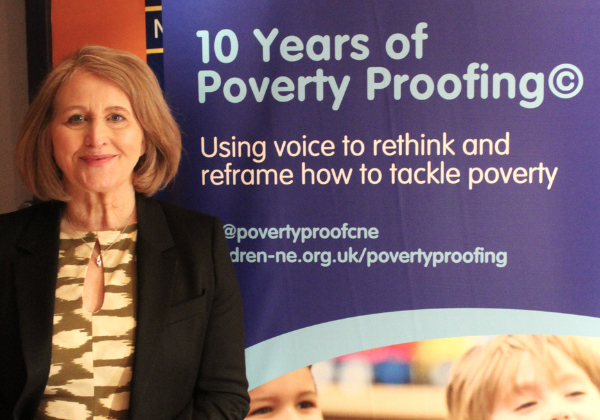
The 10 Years of Poverty Proofing® Conference, held this month at Newcastle’s iconic Discovery Museum was a resounding success, bringing together over 160 policy-makers, researchers and practitioners from across the UK to share learnings from the last decade.
Organised by Children North East, which launched the project in 2024, the event featured an inspiring lineup of speakers, engaging panel discussions and case studies.
Poverty Proofing supports organisations to understand how those living in poverty may struggle to participate in key life experiences, such as education, healthcare and cultural experiences. The event was made possible thanks to funding from Kavli Trust, which has been a significant supporter of Poverty Proofing.
Attendees enjoyed thought-provoking sessions led by prominent figures, including Former Children’s Commissioner for England Anne Longfield, who provided a passionate keynote speech on how we all had a role to play as “warriors for the kids” and asked the audience to help shape a generation that has equal opportunities, no matter their financial background.

Leigh Elliott, Chief Executive at Children North East shared the photographs of poverty taken by children that built the foundations for this now nationally recognised project, explaining “the images along with the stories started to build up a picture of what poverty really meant for these young people, feelings of loneliness, isolation – not a place you would thrive in”.
From that origin story, the conference went on to offer diverse and expert perspectives on how unintentional financial barriers can and have been successfully removed. Examples of success stories include making recycled diabetes technology available to patients and changing how homework is set so pupils without internet access can still participate.
Across 14 speeches and breakout sessions, 27 presenters shared their work in this space including representatives of many organisations, including the National Trust, North East and North Cumbria Integrated Care Board, Stockport Council and Partnerieath.
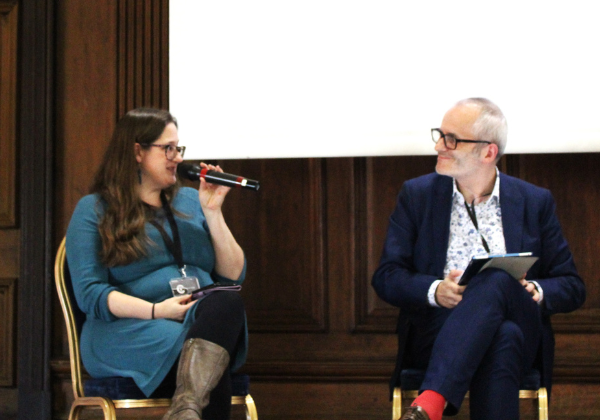
Panel discussions featured lively debate about how different groups could collaborate to achieve lasting change in the fight against poverty, with experts such as John Beeley from Tees Valley Museums and Amanda Bailey from North East Child Poverty Commission sharing their experiences. The interactive workshops allowed participants to delve deeper into their own organisation’s practices, gaining practical skills and insights they can apply in their work.
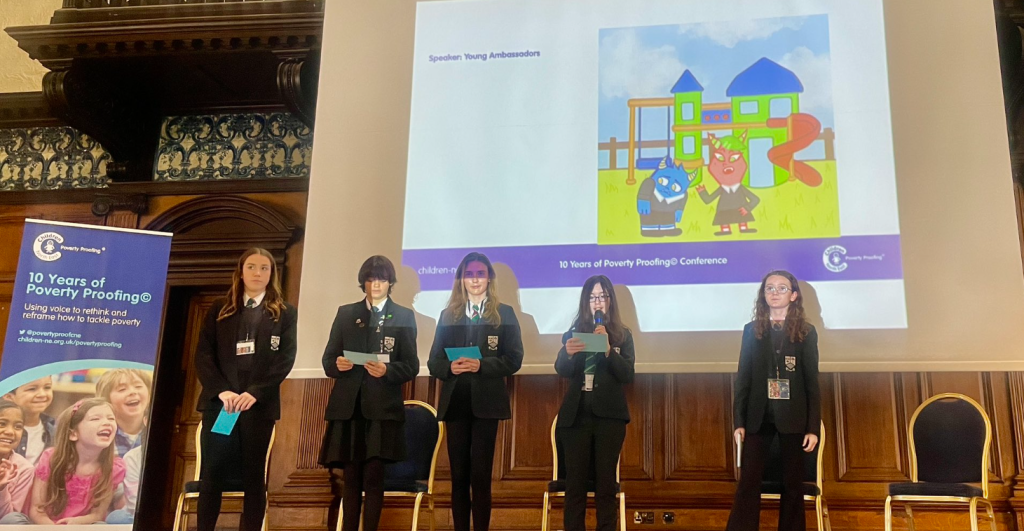
A highlight of the event was a presentation from a group of Young Ambassadors for Poverty Proofing, who presented a new children’s book they have written called ‘Blue’s Sad Day’, sharing stories of what it is like to be poor at school. One guest shared the moment with a tweet reading “Wonderful to hear from children and young people. A hard listen at times, but one which creatively captured the lived reality for far too many children at this time.”
Feedback from guests included: “I can’t deny the atmosphere of hope, confidence and collaboration was so enjoyable to be in the midst of”, that they enjoyed the “friendly open atmosphere from knowledgeable, empathic people” and that there was a “great mix of plenary and more intimate sessions” with “some inspirational discussions”.
As the conference concluded, plans to revisit the impact of the event next year were already underway, promising to capture the ripple effect of learnings and continue to build on the movement Poverty Proofing has created.


18th May 2026
30th April 2026
How Little Minds in Mind Helped One Mum Feel Like Herself Again
16th April 2026
Masquer‑Aid: Building Confidence, Community and Self‑Advocacy
1st April 2026

In October of 2023, our Poverty Proofing® the School Day team headed to Parkhead Primary School to start their week long audit. Staff, parents and pupils alike were all given the chance to express their opinions on access to the school day, including, but not restricted to, themes of uniform, food, pupil support and additional opportunities.
The Poverty Proofing audit at Parkhead Primary school was undertaken by a member of the Poverty Proofing Schools team. They spent some days in school speaking to 324 pupils, staff and parents. There was also a survey sent out to staff, parents and governors to give all those key stakeholders a voice. After the week in school they received a report which consisted of; what we heard or noticed and any practical solutions that could further support families. We want to help break down and remove barriers to getting an amazing school experience for all.
Just over seven months later, we returned to talk to Helen Chard, Parkhead Primary School’s head teacher, and Sarah Lambert, Parkhead Primary School’s family support worker, about how they found the whole Poverty Proofing® process. We discussed what they had been put in place already to improve the school day for their pupils. Helen was new to the school when we carried out the audit but one of Parkhead’s great strengths was that they “already did a lot of poverty proofing practice”. This was definitely seen throughout the audit that Parkhead really did already do a lot for the pupils. Helen explained “We have high pupil premium so we try to do that anyway, but we wanted a fresh pair of eyes to see what else there was; there’s always ways to improve and we had heard good reports from the audit in another school and we thought it was really valuable especially in today’s climate with the cost of living etc”.
We also wanted to discuss the impact of Poverty on their school and what they wanted to address during the audit. Sarah told us that “we have seen a lot of it [poverty] over the years. Its became a real problem not only for those who we had on our radar but for those that we didn’t. It’s really effecting them [families] and a lot more families that we are aware of [are now in poverty]; we have got so many more than we used to”. This runs true with recent statistics across the UK too, with 350,000 more children being pulled into relative poverty in 2021-22. This meant that 4.2 million children were in poverty, a 700,000 child rise since 2020-11.
When speaking about the audit as a whole, Helen explained that “it was a really beneficial audit. Sometimes you do audits and they don’t have the impact you wanted but this was very thorough, easy and there was no impact on staff for time spent [away from usual job]; it was all led by *CNE STAFF MEMBER*. She spoke to nearly every single child rather than cherry picking. The actual report is very good as it picks up on positives, what’s working well, and negatives, what we could improve on. We didn’t feel we had to take all of the solutions either, we could pick things from it. The children spoke very positively of it, being able to speak to someone not linked to the school was good for them”. This was great to hear, as a team we try to be thorough and professional but not intimidating or judgemental; we love seeing how schools are already supporting pupils and their families, while also sharing best practice.
Another important part of Poverty Proofing® is bringing the community and the school on the journey. The continued dialogue between schools and families when there is a good connection can lead to improved programmes and policies which in turn, creates a better school environment for the children or young people.
When we discussed this with Helen and Sarah, they explained during the audit they ‘struggled to get parent voice [from the parent survey] but [CNE staff] didn’t let that become a barrier’. Instead, they recognised this and in response went out onto the yard and spoke to parents face-to-face to gather the voices and hooked in the community that way.’ Giving the parents this voice is extremely important, involving parents in schooling and learning can result in a positive difference in learning outcomes. These strong relationships in turn can then enhance a parents desire to be involved in their children’s educational development.
We also wanted to know what staff, parents and children thought of the Poverty Proofing® process as a whole. Helen told us that “at first staff were like ‘well we already do it’ and there was an element of ‘do we really need it?’ but when it came, staff were like ‘oh yeah, we don’t do that so well’”. It is important to us at Children North East that we reiterate that this isn’t an inspection, this is simply listening to what already supports families, especially those families on low income, and what could further be introduced or considered.
The process also allows a ‘fresh set of eyes’ on the practices in school, highlighting things staff do by intuition that support, and acting as a critical friend around those things that could be considered. When discussing about what the pupils thought of the audit, Helen told us “pupils really found it a positive experience, they liked that we made adaptations so they can see that school listened; ‘we told this lady this, and from that we have changes’. Children got on board because there was a purpose. I think parents appreciated being listed to as well”. Sarah also explained “all feedback was positive from parents and the children”. This is a really positive outcome to the Poverty Proofing© audits- if a child feels like they have been listened to this can have significant effect on their confidence so speak up in the future but also increase opportunities to communicate.
We then asked how working with Children North East team was. Helen told us “they were really approachable, friendly, great with the kids, great with the adults, weren’t frightened to go and approach parents. They made it very relaxing/ at first people [staff] thought ‘oh it’s an inspection’ but CNE weren’t judgemental and it didn’t feel like an inspection after the audit started at all”. This is really great to hear as this is what we strive for during all audits; a non-judgmental, relaxed environment to help improve services.
To round off the conversation with Helen and Sarah, we wanted to discuss the outcomes of the audit and what actions had been taken already. Sarah explained that it was “surprising to see little tweaks we could make to improve and seeing it from another point of view”. Both Helen and Sarah were enthusiastic about Poverty Proofing.
Helen also explained “I think we beat ourselves up a bit like ‘oh goodness our trips are too expensive’ but when we looked at feedback from parents we saw they were happy with how cheap it was in comparison to other schools they had heard. For example, we have no obligation to pay for some things. It was reassuring to hear what the parents thought. It goes back to us thinking out of that box for example making the prepayment plans even better than they were, giving more notice and more options for parents. You always think of certain things of Poverty Proofing such as uniform, but [CNE staff] exposed us to the wider elements which we weren’t really aware of”.
There were many things that Parkhead Primary were already doing before the audit and it seemed as though they already had some great ideas for Poverty Proofing©. Helen said that the audit highlighted their ‘”community corner which provides spruced up and cleaned unwanted uniform that we can give out to any families that need it”.
In addition to this, Helen said, “community corner has food in if parents are struggling. That was a big one we were already doing. Also we had homework club was a big strength too, so they didn’t have to do it at home and weren’t penalised because they had the chance to do homework in the club”. These are both positive practices as often children in poverty don’t always have the resources always to complete homework at home. Sarah also said “we have breakfast club and any leftover bread we take to the yard. We subsidised trips and had parent payment plans and we subsidised leavers hoodies already. We also found that if parents said their child didn’t want a hoodie we did a bit more digging to find out why and can subsidise the cost if needed”. These are all great examples of positive practice happening before the audit and it is great that Parkhead were already looking at their school’s policies from the families’ perspective.
Upon completion of the audit, there were some adjustments and changes suggested based on the voice of children, staff and parents. Helen explained “in the long term, we are thinking wider Poverty Proofing. We are already good at the common strands but the wider elements we want to work on. Short term, we changed things like Easter celebrations; we put in them quick wins that we hadn’t of thought of previously but the children obviously had. The Poverty Proofing audit really put us in the shoes of the child and parents and how they feel; pupil voice was strong when it came through, after all they are the ones living it”.
Sarah also told us that she had “attended an event, made some connections to make our community corner better”. She also said “we will have a huge amount of uniform coming in July so we can tell parents before they go out and buy new for September. Also, the grant application was hopefully going to be used to open a sort-of food bank, so if parents want to get in touch via email confidentially, they can and they don’t have to come and ask in person”.
When asked what they would say to another organisation thinking about undergoing the Poverty Proofing® process, Helen said she would “encourage them to take part because it’s a worthwhile process, you get a lot out of it. It makes you think wider and really understand the whole of Poverty Proofing”. Sarah added to this, explaining, “I think you get to find out about both those families you know about, but also families on top of that which weren’t so much on the radar, that you maybe don’t always think about. I think it would open their eyes a little bit”.
Both Helen and Sarah agreed that schools are “one of the most important people who can address inequalities; they spend the most time with the children, they can find out about families that other organisations maybe wont’ and that there ‘is already a relationship between school and families, they have that trust in [us], they will come and ask for help whereas with outside agencies, they may be more reluctant. Schools are pivotal and often that middle head”.
Parkhead Primary school, and all schools that we work with, are on their journey to ‘Poverty Proof’ all the elements of the school day. With all the positive practice already established within the school and the positive response from staff, parents and children, we are confident that changes to further support will be warmly received, benefitting the whole community. We can’t wait to hear all about it!
If you would like more information about Poverty Proofing® or how your school can get involved, get in touch with the team.
References
18th May 2026
30th April 2026
How Little Minds in Mind Helped One Mum Feel Like Herself Again
16th April 2026
Masquer‑Aid: Building Confidence, Community and Self‑Advocacy
1st April 2026