

18th May 2026
South Shields singer/songwriter Joe McElderry is the latest musician to lend his support to a special charity project which aims to celebrate our region’s rich musical heritage.
Joe joined the young people who attend Children North East’s Fabulous and Brilliant (FAB) Group on Zoom as part of their new ‘Voices of the Tyne’ research.
 ‘Voices of the Tyne’ is all about exploring North East music and giving a platform to both established and emerging artists.
The group is working on a ‘Voices of the Tyne’ website, due to launch in May, which is being built by one of FAB group’s members, Peter, who is studying Computing at Northumbria University.
And Haydon, another FAB attendee, who is studying Technical Theatre at Newcastle College, has conducted interviews with Joe and several other musicians for the filmed Q&As that will appear on the website.
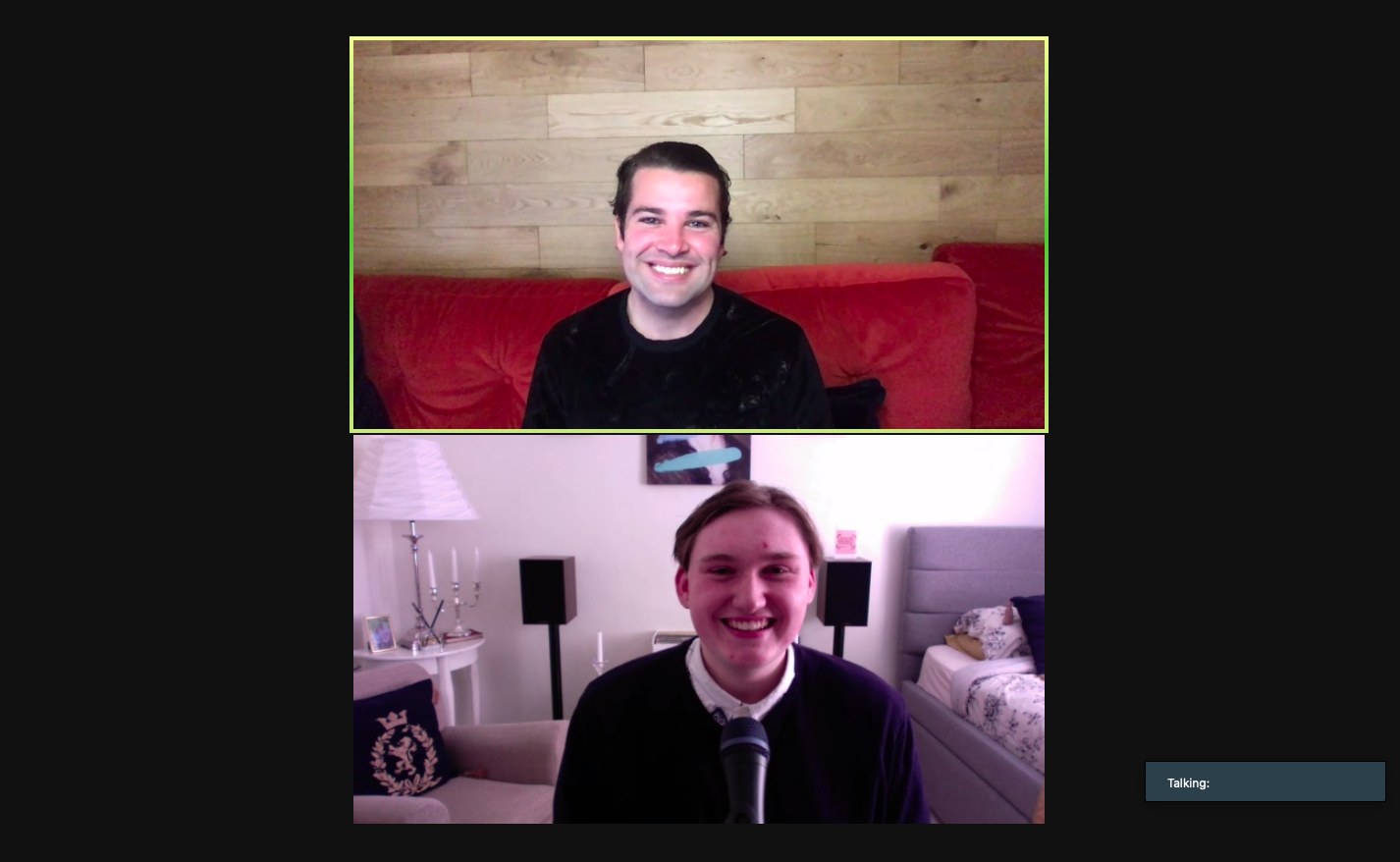 Joe (pictured talking to Haydon above) just happens to be an icon for Haydon and fellow FAB member, Callum and it was a particular thrill for them to meet him.
Haydon said: “Me and Callum are fan boys! My interview didn’t go completely as planned – I had lots of questions written down, including ‘What was it like to work with George Michael?’ but I ended up asking him whether he’d ever thought of getting a Claire’s Accessories sponsorship as he’s been rocking different hair bands during Lockdown!”
Luckily Joe took it all in good humour. Haydon added:
“Joe had no arrogance, he just had this lovely calm, very sweet personality and it was so lovely to meet him.”
Callum is a great fan of the musical, Joseph and his Technicolor Dreamcoat and Joe is his favourite Joseph – in fact he’s seen Joe perform in the show at least three times.
The ‘Voices of the Tyne’ project began in March and Haydon has also chalked up chats with two voices of the Wear – Barry Hyde of art pop group, The Futureheads and Kev Dosdale of Field Music.
Paige Temperley has also had the honour of being interviewed by our Haydon. Paige is an emerging artist with a new single out on Spotify (other streaming services are also available) called Whos’ Gonna Want Me? Why not give it a listen here?
 As if all that wasn’t enough, theatre company, Twisting Ducks have been working with FAB group members, Thomas and William to produce a spoof Ant and Dec comedy sketch, which will also launch on the new website. And dance teacher, Lyn Campbell, of Get Connected, has worked with the group to choreograph a dance to Little Mix’s ‘Shout Out To My Ex’, one of their favourite songs.
The FAB group is for young people with disabilities and meets weekly on Zoom to socialise and have fun. The group also acts as a voice for other disabled young people in Newcastle, sharing their views with decision makers about accessibility issues and sitting on interview panels.
18th May 2026

30th April 2026
How Little Minds in Mind Helped One Mum Feel Like Herself Again

16th April 2026
Masquer‑Aid: Building Confidence, Community and Self‑Advocacy

1st April 2026

Are you looking for a way to spend some time over the Easter holidays? Our fantastic designers have put together this rather lovely colouring ‘book’ that you can download and print to help get your creative juices flowing.
If you scroll to the end of the ‘book’ there’s a fantastic ‘Happy Easter’ colouring sheet that would look lovely stuck in your window to cheer up passers-by too.
18th May 2026
30th April 2026
How Little Minds in Mind Helped One Mum Feel Like Herself Again
16th April 2026
Masquer‑Aid: Building Confidence, Community and Self‑Advocacy
1st April 2026
An ‘administrative’ change to the way in which pupil premium funding is allocated to schools will leave schools in the region short between £5.16 million and £7.26 million in the coming financial year.
The calculation for pupil premium has been changed by the government so that it will now be based on the number of pupils who were eligible for free school meals (FSM) in October 2020, rather than January 2021, as has previously been the case. Analysis of newly-available data suggests there was an increase of 5,400 pupils in receipt of FSM across the North East between the school census of October 2020 and that of January 2021, but schools won’t receive pupil premium funding for these students.
Regional organisations Children North East, Schools North East and the North East Child Poverty Commission have joined forces to write a letter to the Education Secretary to urge him to reverse this decision to change the way in which pupil premium funding is calculated, and to base the pupil premium calculation on the January 2021 census. The Department for Education has repeatedly committed to supporting our schools and ‘to do everything possible to ensure that no child, whatever their background, falls behind as a result of coronavirus.’ However, this change will seriously impact the ability of schools to support a growing number of disadvantaged students in the coming year.
Schools North East Director, Chris Zarraga said:
In a year where many families have faced difficulties with furlough and widespread redundancies, the number of students eligible for pupil premium has increased. However, this decision from the government means schools won’t receive the money they need to properly support those students, and existing high levels of deprivation and a wider gap in learning loss means that schools in our region are likely to be hit even harder than elsewhere. With school budgets already suffering due to continuing outgoing costs of Covid safety measures, this will have a serious detrimental impact on our students who have already suffered significant disruption over the last year.
Director of the North East Child Poverty Commission, Amanda Bailey said:
We all know the Covid-19 pandemic has had a devastating effect on people’s lives and livelihoods and these new figures illustrate quite how stark that economic impact has been for thousands of families across our region, given how stringent the free school meal threshold currently is. It’s not right that some of the most disadvantaged pupils in the North East could lose the additional support they are entitled to as a result of this change, not least after the enormous upheaval they have faced to their education and wider lives over the last twelve months. Providing additional funding with one hand, whilst taking it away with the other totally undermines the Government’s pledge to support students through this pandemic.
Children North East have seen first-hand the challenges many schools and their pupils are experiencing across the region. Some schools Children North East have worked with through their Poverty Proofing the School Day programme have implemented various initiatives as a result of the pupil premium funding. Headteacher of Ridgeway Primary Academy, Alex Golden shared:
Pupil premium allows us to make sure that we can meet children’s needs and make sure that they are not disadvantaged by their out of school experiences.
Assistant Principal at Kenton School, Sarah Price also shared:
In order to support our pupils who are in receipt of the pupil premium we have delivered weekly food parcels to families, supported with utility bills so that they didn’t go cold over the winter, provided access to the internet in order to ensure pupils were able to keep up with their home learning and funded transport to allow vulnerable pupils to attend during the closure.
The joint letter from Children North East, Schools North East and the North East Child Poverty Commission to the Education Secretary can be read here.
Children North East has also prepared a briefing on pupil premium, including further information on what it is, eligibility criteria, how it’s used and case studies from Jarrow School and Kenton School on how this pupil premium is used. You can read or download the briefing here.
18th May 2026
30th April 2026
How Little Minds in Mind Helped One Mum Feel Like Herself Again
16th April 2026
Masquer‑Aid: Building Confidence, Community and Self‑Advocacy
1st April 2026
Children North East is working with North Tyneside Cultural Education Partnership (NTCEP) on a new social prescribing initiative. It’s aimed at increasing connections between the education and cultural sectors as well as raising awareness of the cultural offer in the borough and supporting schools to use the Arts to meet their wider objectives. Eleven-year-old Holly is just one of the young people to have benefited from this partnership.
Having a sibling with a disability can be a positive experience, however there are times when it can also be quite stressful.
For Holly, 11, her five-year-old brother’s autism can mean her mum’s attention is sometimes taken up dealing with his challenging behaviour and this was particularly problematic during lockdown.
So when Holly was matched with a sessional worker from our Young People’s Service, it meant Holly could enjoy a bit of fun and relaxation and her mum, Megan, wasn’t worrying about focusing on her son and her anxious eight-year-old daughter to the detriment of Holly.
Molly, who began as a volunteer peer mentor with Children North East before getting paid work with our charity, quickly acquainted herself with Holly’s varied interests which encompass sharks, sketching and cooking up a storm in the kitchen!

“Holly was quite quiet at first, but we had a couple of meetings and the second time, she opened up and was really quite chatty. We got on really well,” Molly said.
“As well as doing art and cookery together, we did quizzes online. I made up little quizzes about sea life (Holly is really interested in marine biology) and we both made shark posters and told each other about our chosen sharks!”

Before restrictions were tightened again late last year, Molly and Holly were able to go for walks on the beach at Whitley Bay where Molly encouraged Holly to practise her drawing.

This picture of St Mary’s Lighthouse is one of her works of art. However as lockdown came back into force, Molly had to find creative ways to keep Holly interested that didn’t involve in-person activities. They began meeting over Zoom and decided to make a cookbook together.
Holly said:
“We came up with loads of ideas for things to bake – cupcakes, brownies and rocky road. It was really nice. I got a parcel delivered with all the cooking things in and a folder of the recipes. The rocky road was great – we shared it with my grandma and she took some to my great aunt who was shielding.”
Holly loves art and so Molly delivered a pack of arts and craft materials to her home so she could enjoy drawing, in between their cookery sessions.
 Mum, Megan, said:
“I massively appreciated Holly being involved in this, especially in lockdown. My son has autism and his behaviour can be challenging. It can consume a lot of time so to have something just for Holly, something special just for her, at a really hard time in my life and their lives, was fantastic.”
“Holly and Molly really gelled from the outset. All of the things Molly did weren’t just ‘on the day’ activities – there were the arts supplies which meant Holly could be absorbed in her drawing and the cookbook meant we could bake something together too. It really just helped to know Holly was looked after and having enjoyment at a time when there was very little to do.”
As for Molly, 22, who has left Children North East now to concentrate on her final year of a Psychology degree at Northumbria University, she says she got a great deal out of her sessional work.
 “I began as a volunteer peer mentor but then gained a paid post. It’s really rewarding. I think this project helped Holly quite a bit because she was able to chat and just have some time that was just concentrated on her. She’s a really lovely girl and understands that her sister and brother need that extra attention. I felt she really came out of her shell.”
18th May 2026
30th April 2026
How Little Minds in Mind Helped One Mum Feel Like Herself Again
16th April 2026
Masquer‑Aid: Building Confidence, Community and Self‑Advocacy
1st April 2026
Governments, local authorities and schools must make a concerted joint effort to equip families for future home learning by fully addressing their digital needs, a survey of families in the last lockdown suggests.
A joint survey of 1,570 parents and 785 children by our charity and Child Poverty Action Group found 35 per cent of low-income families didn’t have the home learning equipment they needed in the last lockdown. Most commonly, they lacked devices such as a laptop or a tablet.*
 A quarter of pupils on free school meals said they had to share a device with other family members.
Parents described facing impossible choices around home learning because of scarce resources, higher bills, inadequate space and juggling schooling with their work. This ‘permanent battle’ caused stress and guilt for parents and often left less time to focus on learning. The lack of digital tools made it more challenging for pupils to participate in learning from home as they struggled to access online lessons and materials.
We believe that local lockdowns, contact tracing and household isolation mean some pupils will inevitably have to learn from home in the coming months, and so they should be properly equipped to do so.
Our joint survey found that:
Low-income parents reported being more concerned about money than last spring, and the vast majority (90 per cent) had spent more on bills with children at home. Many had faced higher return-to-schools costs in September compared to the previous year, and had spent more on uniforms, extra clothing for outdoor learning, stationery, face masks and hand gel.
Where schools had reduced costs – for example by relaxing uniform policies or loaning out digital devices – parents said it had made a positive difference.
The survey showed that free school meals were valued by families who receive them as they helped them make ends meet, both in normal times and through replacement options when schools were closed. Cash payments directly into parents’ bank accounts were the most favoured replacement option, with 75 per cent of families receiving direct payments saying this was working well or very well for them; this compared to just 40 per cent who said other methods like vouchers and food deliveries were working well. Many low-income families who were not eligible for free school meals said they would have benefited greatly from the extra help.
Based on these findings, CPAG and Children North East want to see:
Luke Bramhall, Poverty Proofing and Participation Service Manager at Children North East, said:
“The findings from the Cost of Learning in Lockdown report have been invaluable for us and for schools across the country in shaping their response to the latest lockdown and the pandemic as a whole. It is sadly no surprise that children caught in the grip of poverty are drowning as they continue to suffer from the digital and resources divide which has been highlighted by the Covid-19 crisis. We encourage schools to take these findings and consider how they can inform the great work they are doing to support the most vulnerable children in our society.”
Alison Garnham, Chief Executive of Child Poverty Action Group, added:
“School disruptions have had a big impact on family life, from finances to learning. The digital divide was exacerbated during school closures, but it didn’t start with lockdown and it won’t go away with pupils back in the classroom. We must bridge the gaps in resources so pupils can fully access their education – whether at school or at home.
We have seen some great examples of schools working alongside families to make learning during lockdown easier. However, the pandemic has hit hard and low-income families need far more financial support from government itself. By providing that support and reducing the cost of the school day, all children can have a chance at fulfilling their potential in life.”
Our Computers for Kids campaign is encouraging local businesses to donate to help buy devices for disadvantaged families. Computer company, Sage, recently made a £30,000 donation and urged other companies to follow suit.
18th May 2026
30th April 2026
How Little Minds in Mind Helped One Mum Feel Like Herself Again
16th April 2026
Masquer‑Aid: Building Confidence, Community and Self‑Advocacy
1st April 2026
A group of Bishop Auckland College students are the latest to add their voices to a major consultation Children North East is conducting in conjunction with Newcastle University.
 The VOICES project is finding out what the younger generation – whose lives are already affected by social and economic deprivation across the region – thinks about, needs and wants during this pandemic.
Lead researcher Professor Liz Todd explains:
“There is a serious knowledge gap in understanding the detailed needs of children and young people in poverty during this pandemic.
Living in poverty is hard and difficult at any time but the COVID-19 pandemic is throwing up new challenges for them – some of which we might not have even considered yet.”
“Often, important decisions about young people’s futures are made without asking them, so we want to address that. It is essential that young people’s voices are heard by policymakers and organisational leaders.”
The VOICES project covers the entire North East region, and is working with 1,000 young people in online focus groups delivered through schools, colleges and community groups. The youngsters are also asked to communicate their experience and needs in a format of their choice, such as writing, drawing or a photo. Some groups will work with artists to make their views heard through videos and comics.
During March, Cathryn Gathercole, from our Poverty Proofing and Participation team, along with her colleague, Andrew Thorp, gathered views at Bishop Auckland College, County Durham.
Students spoke about difficulty with sleeping patterns; transport to and from college and their frustration with lockdown and not seeing friends. But they also acknowledged the positives that have come out of Covid-19 restrictions, such as spending quality time with family and improved community spirit.
Concerns other children in the region have highlighted have included the safety of family members, not wanting to trouble parents/carers who are under pressure and frustration caused by how their lives have changed. One young person said, “My mam’s disabled, I worry I could hurt her by getting an education – I could bring something home.”
Another described how their world has shrunk. “Having to socialise online massively impacts your chance to make those shared experiences, you have nothing to talk about because you’ve been nowhere.”
A child described feeling unable to ask their parent for help with schoolwork. “I don’t get it, I can’t ask the teacher but I know she’s stressed so I said nowt.”
Luke Bramhall, Poverty Proofing and Participation Service Manager, Children North East, said: “Children North East is delighted to be working alongside Newcastle University on amplifying the voice of children and young people across our region. Children’s experiences of Covid should inform how we as a region, and in fact as a nation, should respond to the challenges of a post Covid-19 world.
“Some of the early findings indicate that children feel the virus has brought about significant irreversible change to their lives.
“The importance of robust consultation is paramount, providing a unique insight into this unprecedented time and the opportunity to disseminate this across multiple sectors, will lead to practical help for children and young people in the long-term.”
Policy leaders and practitioners working with children and young people will also be interviewed to investigate how organisations such as schools, statutory services, councils and youth groups are responding to the young living in poverty.
Researchers will also engage with regional and national leaders and practitioners through webinars so the views of children and young people can influence policy and practice. They will revisit these organisations to investigate if this has changed the way they work. Case studies of practice and policy change will be shared nationally as example of good practice.
The 12 month VOICES project is funded by the Economic and Social Research Council (ESRC), as part of UK Research and Innovation’s rapid response to Covid-19.
The VOICES website https://www.voicesproject.co.uk/ has more information for schools, colleges or community groups in the North East who would like to get involved. Contact [email protected] or [email protected].
18th May 2026
30th April 2026
How Little Minds in Mind Helped One Mum Feel Like Herself Again
16th April 2026
Masquer‑Aid: Building Confidence, Community and Self‑Advocacy
1st April 2026