



18th May 2026
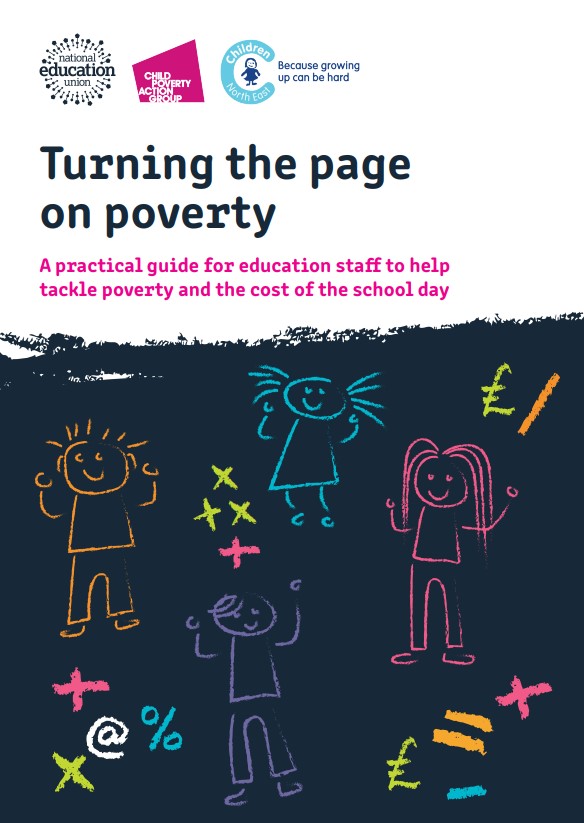
We’ve partnered with Child Poverty Action Group and the National Education Union to publish a new resource for schools, aimed at helping teachers and school staff tackle poverty.
Children North East and Child Poverty Action Group developed the resource, ‘Turning the page on poverty’, based on our years of experience working directly with schools to reduce financial barriers to learning. This year we celebrate ten years of our unique Poverty Proofing the School Day project which creates a level playing field for pupils in the classroom.
 Published in the context of increasing levels of hardship for families, the toolkit highlights the crucial role schools can play to support struggling families. The pandemic has hit household finances hard, particularly families with children, and schools are already recognising the need to support pupils in poverty more than ever.
‘Turning the page on poverty’ is a practical guide for staff, with information on poverty and ideas for how to reduce the costs of the school day. It includes sections on a range of topics related to child poverty in the classroom, including:
 Alongside the toolkit, we’ll be running training workshops with CPAG for NEU members and school staff in England and Wales to help increase awareness of poverty in schools and provide practical ideas and examples of what can be done to improve the school day for children and families in low income households.
Luke Bramhall, Poverty Proofing and Participation Service Manager for Children North East, said:
Since the formation of Poverty Proofing the School Day nearly 10 years ago we have seen the richness and the power in the voice of pupils in informing school staff on what the challenges within the school day are for those caught in the grip of poverty. We are proud to present this resource for school staff as one of the mechanisms of sharing the experiences of children and young people and can see its value in supporting schools in meeting the needs of children who may struggle to access education as a result of the poverty they face.
Alison Garnham, Chief Executive of Child Poverty Action Group, added:
“Our Cost of the School Day programme has been running since 2014, and we know that school staff often go above and beyond to support children and families struggling on low incomes. Our new toolkit aims to help teachers and staff with structured practical advice and recommendations informed by our work with school communities across the country.
By removing financial barriers to learning, schools can help all children access opportunities to learn and participate. We hope NEU members and school staff across the UK will find this resource useful as they continue their valuable work during this difficult time.
But poverty doesn’t stop at the school door. While schools can and do make a difference in their community, it is up to the Government to take action to reduce child poverty in the UK.”
Dr Mary Bousted, Joint General Secretary of the National Education Union, said:
“As a result of the pandemic, we’re facing unprecedented new levels of hardship. This practical resource draws on ideas that schools have developed and tested, before and during Covid 19, in terms of talking about poverty, understanding the stigma and helping families to access other local services.
“In working with Children North East and Child Poverty Action Group, we want to recruit more schools to this approach of thinking reflectively about how poverty affects the school day, how children feel and the attitudes we hold about poverty. It’s time to re-think a great deal about education policy in England if we want to build a fairer system after Covid and we think this resource is timely.
“By sharing good practice between schools, we can build capacity to make a difference and this resource is built on what schools are doing. We must ‘turn the page’ on poverty. Alongside schools’ determined efforts, the Government needs to commit to doing everything that is necessary on income support to ensure children aren’t growing up in poverty. We have to tackle the drastic income inequality in the UK and eradicate the gap in incomes and rise in poverty rather than asking schools to ‘close the gap’.”
18th May 2026

30th April 2026
How Little Minds in Mind Helped One Mum Feel Like Herself Again

16th April 2026
Masquer‑Aid: Building Confidence, Community and Self‑Advocacy

1st April 2026

Our Computers for Kids campaign, launched last year to help more children and young people get online, has received its biggest boost to date thanks to a £30,000 donation by software company, Sage.
And it’s hoped this major cash injection will spur more of the region’s leading businesses to follow suit and donate to help disadvantaged youngsters access technology.
 According to analysis from the Northern Powerhouse Partnership, at least 55,000 families in the North East do not have access to a laptop, tablet or desktop computer. Digital exclusion can lead to less access to education and jobs and social isolation in later life.
Each £200 funds a digital device, connectivity and distribution for a child or young person. Sage is calling on other businesses to help raise £100,000 as this would provide the region’s children with 500 new, data-enabled laptops; a significant contribution towards ending digital poverty in the North East.
Any individuals or companies wishing to donate can do so by clicking the box below.
Paul Struthers, MD UKI, Sage, said: “The pandemic has accelerated use of technology in schools, although in turn it has exacerbated the impact of digital exclusion of some children.
“This is not a problem that will diminish when schools reopen as normal; it needs to be part of a vision where all can benefit from the huge advantages access to digital can bring to education.
“We’re delighted that our donation will have such a positive impact in this region. But we are also asking other businesses to follow suit and donate what they can to support families in their communities that need it most.”
Leigh Elliott, Chief Executive of Children North East, said: “Children North East is liaising closely with schools across the region who have been working tirelessly to identify those pupils most significantly impacted by Covid-19. Our charity will ensure those children get access to all the digital technology and connectivity they need to engage in their schoolwork and activities.
“This is not just a short-term issue, it is more important than ever to look at a long-term sustainable approach in ensuring all children and young people, especially those suffering the effects of poverty, get access to online learning.
“Sage has provided our campaign with a massive boost, our biggest donation to date, in purchasing new devices and we are delighted to be able to offer more businesses the chance to get behind this at such a difficult time for many families.”
The £30,000 Sage donation will be funnelled to the North of Tyne Combined Authority area, where the company’s new global head office will be based when it opens at Cobalt Business Park. This builds on a £20k donation the company made in 2020 to the combined authority’s Digital Inclusion programme.
18th May 2026
30th April 2026
How Little Minds in Mind Helped One Mum Feel Like Herself Again
16th April 2026
Masquer‑Aid: Building Confidence, Community and Self‑Advocacy
1st April 2026

During the first lockdown in 2020, alongside Child Poverty Action Group (CPAG), we conducted surveys and heard from thousands of parents, children and young people in the UK about their experience of learning in lockdown. This research was incredibly useful and helped shape recommendations to schools, councils and government about how best to support families.
We have now launched new surveys asking families about their experience this year. If you’re a parent or carer with school-aged children, we would love to hear from you and your children. Please complete our surveys to let us know what has been working well for you this year and what could be improved.

18th May 2026
30th April 2026
How Little Minds in Mind Helped One Mum Feel Like Herself Again
16th April 2026
Masquer‑Aid: Building Confidence, Community and Self‑Advocacy
1st April 2026
Staff and students from Durham University have raised more than £1,300 for Children North East and Chester-le-Street’s REfUSE thanks to their Christmas Wish Tree appeal.
Each festive season the University’s Student Union chooses the causes they wish to support and our charity was one of those selected.

Durham University’s Wish Tree
The Christmas Wish Tree campaign was however a little different this time due to Covid-19. Liz Waller, Director of University Library and Collections, University Librarian, said:
We are unbelievably grateful to everyone who contributed to our Christmas Wish Tree fundraising efforts, particularly during these uncertain times.
“In previous years, we have asked our University community to purchase specific items from the charities’ wish lists, wrap them and return them to our Bill Bryson Library to put under the tree. With the pandemic forcing us to change our approach and ask for monetary donations we were concerned about what people might contribute. The result though is amazing and we are thrilled with the total donated to each of our chosen charities.”

Donations go to a variety of projects, including our craft resource packs for children
Our Chief Executive, Leigh Elliott, said: “We are so grateful to the staff and students at Durham University for this fantastic donation. Many of the families we work with will be experiencing real problems under this current lockdown and this will enable us to continue to provide food parcels, resource packs and other help to our beneficiaries. Thank you to everyone who took part.”
Nikki Dravers, founder of REfUSE, a surplus food redistribution charity that also runs a community cafe, added: “Our hearts broke reading some of the messages we received this Christmas, hearing just how much people are struggling to even put a meal on the table for their families.”

REfUSE redistribute surplus food that would otherwise be wasted
18th May 2026
30th April 2026
How Little Minds in Mind Helped One Mum Feel Like Herself Again
16th April 2026
Masquer‑Aid: Building Confidence, Community and Self‑Advocacy
1st April 2026
Thanks to funding from the Co-op Foundation, we’re setting up a unique project to help primary pupils settle into secondary school.
We’re going to use the £67,885 funding to set up an innovative peer mentoring programme within Burnside Business and Enterprise College, North Tyneside which is expected to benefit more than 1,000 young people over two years.

The Co-op Foundation awarded the grant as part of a £3m extension to its #iwill Fund, designed to empower young people to improve spaces, wellbeing and skills.
Luke Bramhall, our School Research and Delivery Manager, said: “We’re delighted to have received this funding and to be embarking on this work with Burnside Business and Enterprise College and its feeder primary schools.
“The step up to secondary education is an important stage in young people’s lives and we hope this project will lead to a smoother transition for primary pupils and provide secondary peer mentors with valuable life skills, alongside inspiring them in social action.”
Charlotte Jenkins, Deputy Headteacher at Burnside Business and Enterprise College, added:
“We are excited to continue our work with Children North East and for some years now we have been working towards ensuring students are ready for their arrival at secondary school and that they feel they can contribute positively within the school and wider community.
“This unique project will allow those younger students to benefit from mentorship and guidance from our sixth form peer mentors who consistently prove how excellent they are as role models. It will be great to see them working together and hopefully increasing engagement in extracurricular activities as well as their learning in school.”
The #iwill Fund is a £50 million joint investment from the National Lottery Community Fund, using National Lottery funding, and the Department for Digital, Culture, Media and Sport (DCMS) to support young people to access high quality social action opportunities. The Co-op Foundation acts as a match funder.
Co-op Foundation is the Co-op’s charity. It helps people challenge inequality and co-operate for change so they can share a fairer future.Subscribe to the Co-op Foundation blog to find out first when funding applications open: www.coopfoundation.org.uk/blog.

18th May 2026
30th April 2026
How Little Minds in Mind Helped One Mum Feel Like Herself Again
16th April 2026
Masquer‑Aid: Building Confidence, Community and Self‑Advocacy
1st April 2026
As a result of the latest lockdown, we and Child Poverty Action Group have written an open letter to Secretary of State for Education Gavin Williamson, calling on the Government to take a child and family-centred approach to home education during this lockdown.

That’s why we are urging the Government and MPs to support our call to:
We know that schools are working tirelessly to support pupils and their families, but we now need the Government to play its part and hope the government uses these guiding principles to help make decisions about home education.
18th May 2026
30th April 2026
How Little Minds in Mind Helped One Mum Feel Like Herself Again
16th April 2026
Masquer‑Aid: Building Confidence, Community and Self‑Advocacy
1st April 2026